

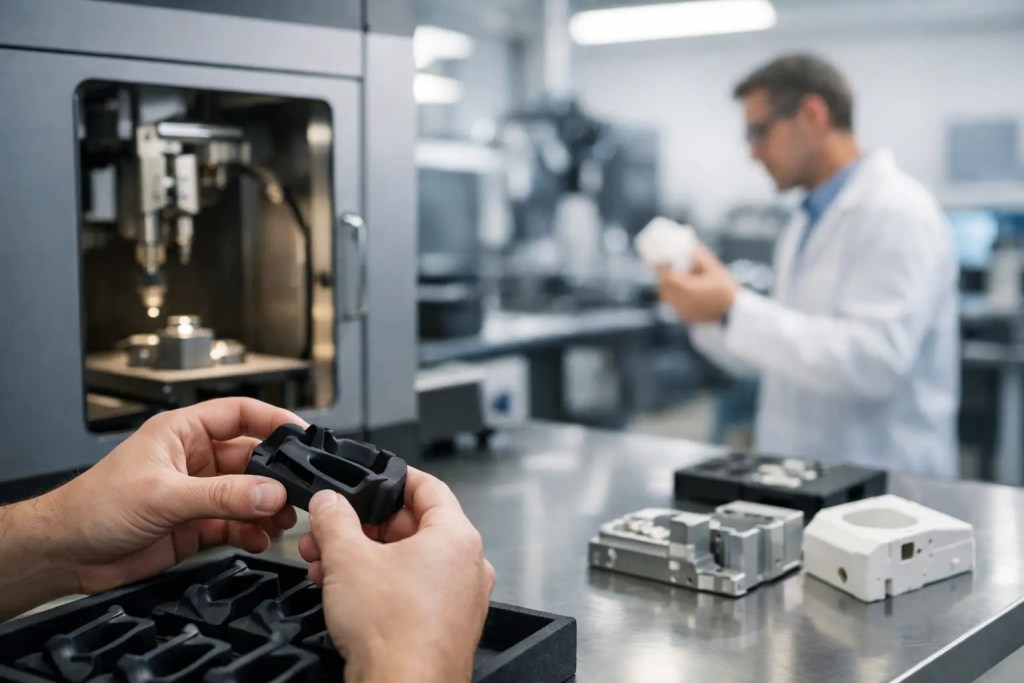
A pilot build of 50 parts can expose more production risk than a prototype ever will. Tolerances that looked acceptable in a one-off sample may drift in a short run, assembly time can spike, and a material that worked in testing may create avoidable cost at scale. That is why a guide to low volume manufacturing needs to focus on process control, not just part count.
Low volume manufacturing sits between prototyping and mass production. In most programs, it covers anything from a few units to several thousand, depending on part complexity, tooling strategy, and demand certainty. For engineers, product teams, and procurement managers, the value is straightforward: validate design, support market launch, and produce end-use parts without committing too early to full-scale tooling or internal capacity.
What low volume manufacturing actually solves
Low volume manufacturing is not simply a cheaper version of mass production. It serves a different operational purpose. It helps teams bridge the gap between design intent and repeatable output while keeping lead times and capital exposure under control.
This matters when product demand is uncertain, when design changes are still likely, or when the part itself does not justify high-volume tooling. Medical devices, industrial equipment, robotics assemblies, spare parts, and custom enclosures often fall into this category. So do bridge production runs before injection molds or hard tooling are approved.
The main advantage is flexibility. The trade-off is that unit economics depend heavily on choosing the right process early. A poor process choice can make a 200-part run slower, more expensive, and less consistent than it needs to be.
A guide to low volume manufacturing process selection
The correct process starts with function, not preference. Engineers often begin with geometry and tolerance requirements, then work outward to material performance, cosmetic expectations, and production volume. That sequence usually leads to better decisions than choosing a technology because it is familiar or fast in a prototype setting.
Additive manufacturing for speed and design freedom
Industrial 3D printing is often the strongest option for low volume production when parts need to move quickly and geometry would be difficult or wasteful with subtractive methods. It removes tooling lead time, supports rapid iteration, and can produce complex internal features, lattices, or consolidated assemblies.
For polymer parts, Multi Jet Fusion and SLS are commonly used for functional housings, brackets, ducts, and snap-fit components. Materials such as PA12 and PA11 offer a practical balance of strength, dimensional stability, and production repeatability. SLA is useful when fine detail or smooth surface finish matters more than impact resistance, while FDM can be effective for larger, lower-cost functional parts when tolerances are less critical.
For metal applications, SLM supports low volume production of lightweight brackets, heat-resistant components, and geometries that benefit from internal channels or part consolidation. Materials such as AlSi10Mg and SS316L are selected when performance requirements justify additive complexity.
The limitation is that additive manufacturing is not automatically the best choice for every short run. Surface finish, anisotropy in some processes, and post-processing requirements can affect final cost and throughput. If the design is simple and tight tolerances dominate, CNC machining may be the better production path.
CNC machining for tight tolerances and material certainty
CNC machining is often the preferred route for low volume metal and plastic parts that require precise tolerances, predictable mechanical properties, and conventional engineering materials. It works well for housings, fixtures, mounting plates, manifolds, and structural components where geometry is accessible by cutting tools.
Compared with additive, machining usually offers stronger consistency in critical features and broad compatibility with production-grade materials. If your part must perform in aluminum, stainless steel, acetal, PEEK, or another specified stock material, CNC can reduce qualification risk.
The trade-off is geometry. Complex internal channels, undercuts, or designs with heavy material removal can drive cost up quickly. For a short run, that may still be acceptable if tolerance and material requirements are non-negotiable.
Injection molding and casting for repeatable short runs
When quantities rise and the design is stable, tooling-based methods begin to make sense. Injection molding is often the most efficient path for larger low volume runs, especially if unit cost matters and the geometry fits molding rules. Aluminum tooling or bridge tooling can support short-run production without the investment required for hardened production molds.
Vacuum casting or urethane casting fills another useful space. It is well suited for smaller batches that need good cosmetic quality and material properties close to molded parts. This can be an effective choice for pre-production builds, customer samples, and market testing.
These methods offer better per-part economics as volume increases, but they are less forgiving when design changes are still active. Once tooling begins, engineering flexibility decreases.
How to choose the right process for your part
A practical guide to low volume manufacturing should reduce selection to a few measurable questions. Start with volume, but do not stop there. Volume alone does not determine the process.
First, define the part’s role. Is it a visual model, a functional test part, a production bridge component, or an end-use part? The answer affects how much weight to place on cosmetics, accuracy, mechanical properties, and repeatability.
Next, look at quantity across time, not just in a single order. A run of 300 parts once is different from 300 parts every month. Recurring demand can justify tooling or fixture investment that a one-time batch cannot.
Then evaluate material requirements. Heat resistance, chemical exposure, impact strength, stiffness, flame rating, and biocompatibility all narrow the field quickly. If a part must perform in PA12, anodized aluminum, or SS316L, the right process usually becomes clearer.
Finally, account for secondary operations. Tapping, inserts, machining after printing, bead blasting, vapor smoothing, painting, and inspection all affect cost and lead time. Low volume programs often succeed or fail in post-processing, not in primary production alone.
Supplier capability matters as much as process choice
A capable low volume manufacturing partner should do more than make parts. It should help you avoid process mismatch, identify manufacturability risks early, and maintain consistency from prototype through repeat production.
That is where quality systems matter. ISO 9001:2015 certification is not a marketing detail. It signals documented workflows, traceability, and controlled production practices that reduce variation across batches. For engineering teams, this becomes especially important when parts move from R&D into customer-facing or operational use.
Breadth of capability also matters. Programs rarely stay in one process forever. A printed prototype may move to CNC for tighter tolerance validation, then to urethane casting or injection molding for launch quantities. Working with a manufacturing partner that supports additive, machining, molding, fabrication, and finishing under one operational framework reduces handoff risk and shortens procurement cycles.
This is where a service bureau such as Additive3D Asia can be operationally useful. When quoting, process selection, material matching, and production execution happen within one standardized workflow, teams spend less time coordinating vendors and more time making release decisions.
Common mistakes in low volume production
The most common mistake is treating prototype success as proof of production readiness. A part that prints well once may not be optimized for repeat assembly, finishing, or inspection. Low volume manufacturing should be used to validate the production method, not just the design.
Another mistake is selecting a process based on the lowest quoted part price. If that process requires excessive manual finishing, suffers from inconsistent lead times, or creates fit issues in assembly, the real program cost rises fast.
Teams also underestimate documentation. Revision control, inspection criteria, and finish specifications matter even at low volumes. Without them, every reorder becomes a new project.
Low volume manufacturing works best when it is treated as a controlled production stage with clear engineering intent. If you define the part function, quantify the real requirements, and choose a supplier with process depth and quality discipline, short-run production becomes a useful decision tool rather than a stopgap. The best result is not simply getting parts faster. It is getting parts you can rely on when the next build matters more than the first.