
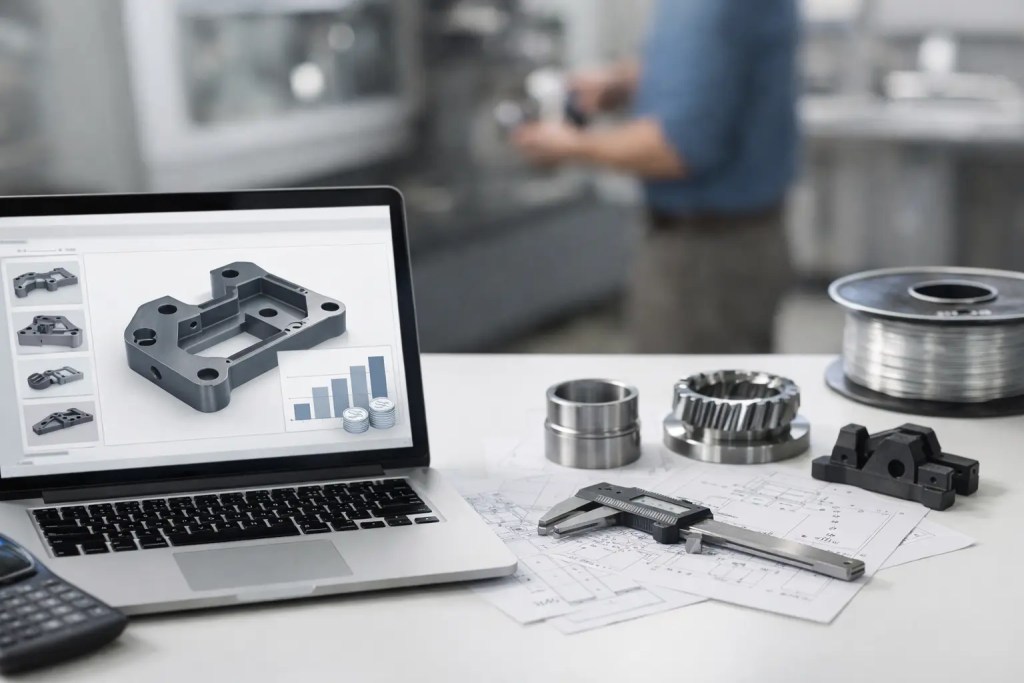
A part that looks simple in CAD can become expensive the moment it hits production rules. Thin walls, deep pockets, unsupported features, cosmetic finish requirements, and tight tolerances all change how a supplier prices risk, machine time, and post-processing. That is why an online manufacturing quote is not just a price check. For engineering and procurement teams, it is an early signal of whether a design is aligned with real production constraints.
The best quoting workflows do more than calculate cost. They connect file data, process capability, material selection, and delivery targets into a practical sourcing decision. When that happens, teams move faster because they are not waiting days for manual review just to find out a part should have been redesigned for a different process.
What an online manufacturing quote should actually tell you
A useful quote should answer more than one question. Yes, price matters, but price without context is not enough for production planning. Engineers need to know whether the selected process can achieve the geometry, whether the material matches the performance requirement, and whether the quoted lead time is realistic for the requested quantity.
That is where digital quoting becomes valuable. A capable system reads the uploaded CAD file, evaluates manufacturability, and maps the part to a process such as HP Multi Jet Fusion, SLS, SLA, FDM, CNC machining, injection molding, sheet metal fabrication, or metal SLM. It should also account for the variables that tend to create downstream issues: tolerances, orientation, surface finish, support strategy, and post-processing.
For procurement, the quote should reduce ambiguity. It should be clear what is included, what assumptions were made, and whether secondary operations such as vapor smoothing, bead blasting, dyeing, anodizing, machining, or assembly are part of the scope. If those details are missing, the quoted price may be low only because the real work has not been captured yet.
The biggest cost drivers in an online manufacturing quote
Geometry complexity
Geometry is usually the first cost multiplier. In additive manufacturing, complexity is often less punitive than in subtractive methods, but it is never free. Build height, nesting efficiency, support requirements, and risk of warpage all affect cycle time and yield. In CNC machining, complexity shows up through setup count, tool access, workholding difficulty, and programming time.
A part with internal channels, lattice structures, or organic surfaces may be ideal for additive processes and inefficient for machining. The opposite is also true. A flat aluminum bracket with tight hole positions may be quoted far more competitively in CNC than in polymer 3D printing if dimensional control is the main requirement.
Material selection
Material choice changes both unit price and process fit. PA12 and PA11 are common polymer options for functional parts because they balance strength, accuracy, and production repeatability. SLA resins may deliver finer detail and smoother surfaces, but not always the same mechanical durability. Metals such as AlSi10Mg and SS316L bring very different economics because powder cost, machine cost, heat treatment, and post-machining requirements are higher.
The trade-off is not just raw material price. It is the total production path. A lower-cost material that requires extensive finishing or fails functional testing is not cheaper in practice.
Tolerances and inspection requirements
This is where many quotes shift quickly. Standard manufacturing tolerances are one thing. Tight, feature-specific tolerances are another. If a drawing calls for critical dimensions beyond normal process capability, the supplier may need secondary machining, more inspection time, custom fixturing, or a different process entirely.
Inspection requirements matter as well. First article reports, dimensional inspection records, material certificates, and traceability controls all add value, especially in regulated or quality-sensitive environments, but they also add cost. For serious production work, that cost is often justified because it reduces risk later.
Surface finish and post-processing
Parts are rarely used exactly as printed or machined. Cosmetic surfaces, smooth sealing faces, tapped threads, inserts, vapor smoothing, polishing, bead blasting, painting, plating, or anodizing all extend the workflow. In additive manufacturing, post-processing can be the difference between a concept model and an end-use part.
This is one reason low headline prices can be misleading. A quote that excludes finishing may look attractive until the team realizes the part still needs multiple operations to meet use-case requirements.
Quantity and lead time
Quantity changes almost everything. For one-off prototypes, setup time and engineering review are a large share of cost. For short-run production, nesting, batch efficiency, and process repeatability become more important. For higher volumes, injection molding or urethane casting may overtake additive methods once tooling and per-part economics make sense.
Lead time also has a direct impact. Expedited jobs can disrupt machine scheduling, inspection capacity, and finishing queues. Fast turnaround is valuable, but it is rarely free. Good suppliers make that trade-off visible so teams can decide whether speed or lowest cost matters more for a given build.
Why instant pricing alone is not enough
An instant price is useful, but it should not be mistaken for engineering validation. Automated quoting works best when it is paired with manufacturability guidance and process knowledge. A system can detect obvious issues, but experienced review still matters for parts with demanding tolerances, load-bearing requirements, thermal exposure, or complex assemblies.
That is especially true across multiple technologies. The right answer is not always additive. Sometimes a prototype starts in SLS or MJF for speed, then moves to CNC or injection molding as the design matures. A quoting workflow should support that lifecycle rather than forcing every job into one process.
For teams sourcing both prototypes and production parts, this matters operationally. You want continuity in quality control, documentation, and engineering support as the part moves from iteration to release. That is why multi-process suppliers often create less procurement friction than managing separate vendors for each manufacturing stage.
How to get a better online manufacturing quote
The quality of the quote depends heavily on the quality of the input. Uploading a clean STL or STEP file is the start, not the full requirement. If the part has critical dimensions, mating surfaces, load cases, or environmental requirements, those need to be stated clearly.
A good quoting request usually includes intended application, quantity, target material, finish expectations, and any tolerance callouts that differ from standard process capability. If the part is a jig, fixture, enclosure, fluid-contact component, or end-use assembly part, say so. That context can change the recommended process immediately.
It also helps to separate what is necessary from what is preferred. Many teams overconstrain drawings by applying tight tolerances everywhere when only a few features are function-critical. That increases quote cost without improving performance. If suppliers understand which surfaces and dimensions truly matter, they can price more accurately and recommend more efficient production routes.
What reliable quoting looks like in practice
Reliable quoting is consistent, traceable, and aligned with real manufacturing outcomes. It should connect digital speed with controlled execution. That means the quoted process, material, and lead time should reflect actual machine availability, validated workflows, and inspection discipline rather than a generic estimate.
This is where quality systems matter. An ISO 9001:2015-certified environment does not guarantee the lowest price, but it does support repeatability, documented controls, and clearer handling of revisions, nonconformance, and inspection records. For engineering teams, that structure is often worth more than saving a small amount on a part that arrives late or out of spec.
At Additive3D Asia, that approach is built around a one-stop workflow that spans polymer and metal additive manufacturing alongside CNC machining, molding, casting, sheet metal, and finishing. For customers, the advantage is straightforward: fewer handoffs, more process options, and quoting that supports both prototype speed and production discipline.
When to question a quote
A quote deserves a second look if it seems unusually cheap, unusually fast, or vague about assumptions. Missing post-processing, unrealistic tolerances, undefined material grades, and broad lead-time language are common warning signs. Another signal is when no one asks about the application. If the supplier has not asked how the part will be used, they may not be pricing the real requirement.
The opposite can happen too. A high quote is not always overpricing. It may reflect a process that genuinely fits the drawing better, or it may include inspection, finishing, and packaging requirements that others left out. Comparing quotes line by line is far more useful than comparing only the total.
An online manufacturing quote works best when it functions as an engineering checkpoint, not just a shopping cart. If it helps your team choose the right process, avoid preventable redesigns, and place orders with confidence, it is doing exactly what it should.