
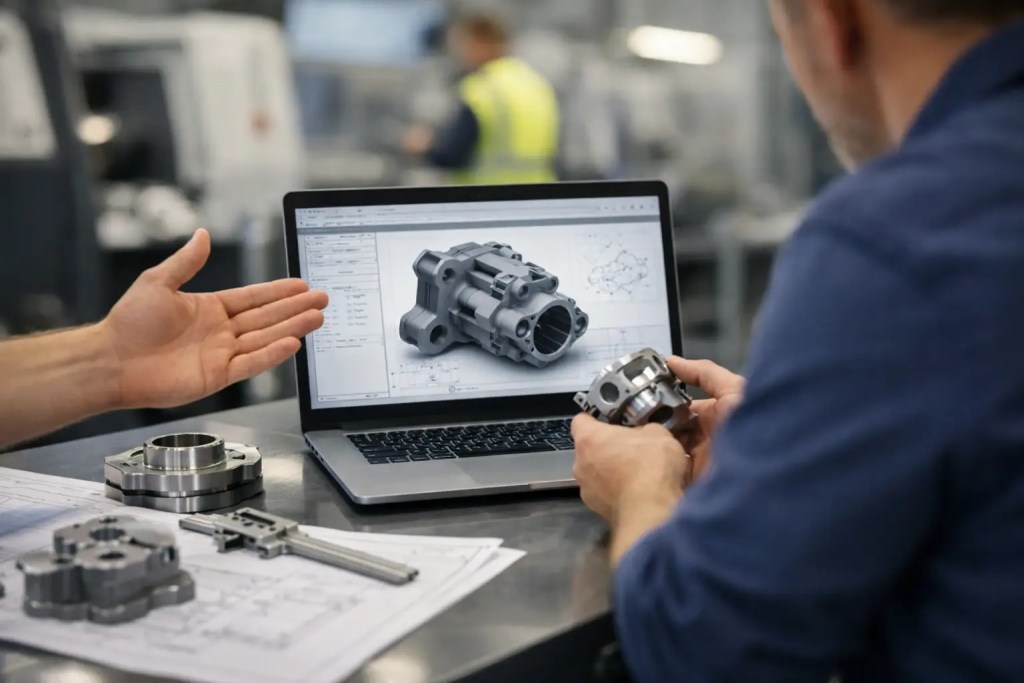
A CAD model can look complete on screen and still contain features that drive cost up, delay production, or fail in the selected process. That is why what is manufacturability review in quoting is more than a pricing question. It is the early engineering check that connects a part’s design intent to the realities of materials, machines, tooling, tolerances, and post-processing.
For engineers and procurement teams, the outcome is practical: a quote that reflects how the part can actually be made, not simply a calculation based on its size and volume. A thorough review identifies risks before an order enters production, when changing a wall thickness or tolerance is far less costly than reworking finished parts.
What Is Manufacturability Review in Quoting?
Manufacturability review in quoting is the evaluation of a submitted CAD file to determine whether it can be produced reliably using the requested manufacturing process and material. It is often described as a design for manufacturing, or DFM, review. During the quotation stage, the review also confirms the likely production route, lead time, finishing requirements, and cost drivers.
The scope depends on the process. An HP Multi Jet Fusion PA12 part is assessed differently from an SLA prototype, a CNC-machined aluminum component, or a metal SLM bracket in AlSi10Mg. Each process has its own limits for minimum wall thickness, feature resolution, support requirements, tolerances, surface condition, and build orientation.
The review does not assume that every non-ideal feature makes a part impossible to manufacture. Instead, it establishes what is feasible, what needs adjustment, and what trade-offs apply. A thin wall may be printable but fragile in service. A tight tolerance may be achievable but require secondary machining. An internal channel may work only if trapped powder or resin can be removed. These decisions affect both the quoted price and the reliability of the delivered part.
Why a Quote Needs More Than Geometry and Quantity
Instant quoting systems can quickly calculate a preliminary price from file geometry, material, quantity, and selected process. That speed is valuable, particularly during prototype iteration. However, reliable production quoting requires engineering context.
Two parts with the same bounding-box dimensions can have very different manufacturing requirements. One may be a simple housing with uniform walls and open features. The other may contain unsupported overhangs, deep narrow cavities, fine embossed text, mating interfaces, and a cosmetic finish specification. The material volume may be similar, but the preparation, build strategy, labor, inspection, and post-processing effort are not.
A manufacturability review makes these differences visible before production begins. It helps avoid three common commercial problems: a price that must change after order placement, a lead time that grows because a design issue was discovered late, and parts that meet the drawing but do not perform as intended.
For procurement, this creates a more dependable basis for comparing suppliers. The lowest initial price is not always the lowest total cost if it excludes necessary finishing, inspection, or design changes identified later.
What Engineers Check During the Review
A productive review begins with the intended function of the part. Is it a fit-check prototype, a functional test component, a jig or fixture, a cosmetic enclosure, or an end-use production part? The answer determines whether the priority is speed, dimensional accuracy, strength, heat resistance, finish, or repeatability.
Geometry and feature limits
The reviewer checks whether walls, pins, holes, text, ribs, and small details are appropriate for the selected process. In polymer additive manufacturing, thin features may warp, break during depowdering, or lack the stiffness required for use. In metal additive manufacturing, small holes and enclosed channels may be difficult to clear of powder or may need machining after printing.
Geometry checks also identify sharp internal corners, unsupported bridges, enclosed voids, inaccessible surfaces, and features that could trap material. In CNC machining, tool access matters. A deep pocket with a small corner radius may require a long, narrow tool that increases machining time and reduces accuracy. In injection molding, draft angles, wall uniformity, undercuts, and gate location become central considerations.
Material and process fit
The requested material may not match the component’s operating environment. A PA12 part offers a strong balance of durability and flexibility for functional polymer components, while PA11 can be preferable where higher ductility is needed. SLA materials can deliver fine detail and smooth surfaces, but their mechanical performance and long-term environmental resistance vary by resin.
For metal parts, the review considers load direction, corrosion exposure, operating temperature, and finishing needs. SS316L may be appropriate for corrosion resistance, while AlSi10Mg supports lightweight, complex geometries. The right choice depends on the complete requirement, including whether the part needs threads, sealing faces, wear surfaces, or certified material traceability.
The process choice can change as the design matures. Additive manufacturing may be the fastest route for early iterations and low-volume complexity. CNC machining may be more suitable for tight tolerances or machined interfaces. For repeat quantities, injection molding or urethane casting may lower unit cost. A competent quoting review evaluates these options without forcing a part into a process that does not fit its production stage.
Tolerances, datums, and inspection requirements
A drawing can specify a tolerance that is technically achievable but commercially inefficient across every feature. The review separates critical dimensions from non-critical ones and checks that tolerances are tied to meaningful datums. This is especially important when a printed component includes mating faces, bearing bores, threaded inserts, or assemblies with other manufactured parts.
General additive tolerances may be suitable for external envelope dimensions, but precision interfaces often require machining, reaming, or selective finishing. Calling this out at quotation avoids ambiguity. It also allows the supplier to plan inspection methods, whether that means basic dimensional checks, first article inspection, or documented measurement against defined critical features.
Orientation, supports, and surface requirements
Build orientation influences strength, dimensional behavior, support marks, and surface quality. For example, orienting an SLM part for structural performance may create support removal work on a noncritical surface. Orienting it for easier finishing may increase build height and cost. There is rarely one universally correct orientation.
Surface requirements deserve the same scrutiny. A customer may need a smooth cosmetic face, a low-friction sliding surface, or a rougher texture for grip or paint adhesion. As-printed, bead-blasted, vapor-smoothed, machined, polished, anodized, and painted finishes all produce different results. The review aligns the requested finish with accessible surfaces and the selected process.
How Manufacturability Findings Change the Quote
The best manufacturability feedback is specific enough to support a decision. It may confirm that a file is ready for production, recommend a different material, or identify one or two revisions that improve yield and cost.
A change can affect the quote in several ways. Increasing a wall thickness may improve part stability without a major cost impact. Opening an enclosed cavity may allow powder removal and make metal printing viable. Relaxing a nonfunctional tolerance may eliminate secondary machining. Conversely, adding machined datums or heat-set inserts can increase cost but deliver the assembly accuracy required by the application.
The quote should make these implications clear. Engineers need to know whether a recommendation is mandatory for manufacturability, preferred for reliability, or optional for cosmetic improvement. Procurement teams need to see whether the change affects unit price, one-time setup, turnaround, or all three.
This is also where quantity matters. A feature that is acceptable for five prototype parts may become a yield risk at 500 units. A secondary operation that is reasonable for a short run may justify a redesign or a tooling-based process for recurring production. Manufacturability is not a fixed property of geometry alone. It depends on volume, quality requirements, and the intended production route.
How to Submit a File for a Faster, More Accurate Review
A clean STEP file is usually best when the part may require machining, tolerance evaluation, or process comparison because it preserves native geometry. STL files are suitable for many additive workflows, provided their mesh resolution accurately represents the model. Include drawings when critical dimensions, threads, datum schemes, or inspection requirements are not fully defined in the CAD file.
Provide the function of the part alongside the file. State the material preference if one exists, but also describe the performance need: load, temperature, chemical exposure, electrical requirements, appearance, and expected quantity. A request that says “PA12, black” is useful. A request that says “PA12, black, fixture jaw, repeated clamp load, must not mark a painted aluminum surface” gives the reviewer the information needed to recommend a dependable solution.
When timing is critical, identify the true deadline and whether a first article is required before the full run. This allows the manufacturing team to distinguish between the fastest possible route and the most controlled route.
Turning Quoting Into a Production Decision
A manufacturability review is valuable because it moves engineering discussion to the point where change is fast and inexpensive. It protects the schedule, clarifies the production method, and gives the quoted price a stronger connection to actual manufacturing work.
At Additive3D Asia, that review supports a practical workflow: upload the CAD file, assess process and material fit, confirm production requirements, then manufacture and ship against a defined plan. For a prototype, the recommendation may prioritize turnaround. For an end-use component, it may prioritize repeatability, inspection, and finishing control.
The most useful quote is not simply the fastest number returned to a screen. It is the one that tells your team what will be made, how it will be made, and what must be resolved before the part reaches the production floor.