
A prototype that survives the lab but fails on the factory floor is expensive noise. That is why the real question behind can 3d printed parts be production parts is not whether additive manufacturing is possible, but whether it can deliver repeatable performance, traceable quality, and commercial lead times for end-use applications.
The short answer is yes. 3D printed parts can absolutely be production parts. The longer answer is that they are production parts only when the process, material, geometry, inspection plan, and post-processing are matched to the application. For engineers and procurement teams, that distinction matters. A part made additively is not automatically production-ready simply because it looks good out of the machine.
When can 3D printed parts be production parts?
3D printing becomes a production method when the part meets the same operational requirements expected from any other manufacturing route. That usually means dimensional consistency, mechanical performance, documented material selection, and a stable workflow from file release to delivered parts.
In practice, additive is strongest in three production scenarios. The first is low- to mid-volume end-use parts where tooling costs make injection molding or die casting inefficient. The second is complex geometry that would be difficult, slow, or wasteful to machine conventionally. The third is bridge production, where teams need market-ready parts while permanent tooling is still in development.
This is why blanket statements about additive often miss the point. A PA12 housing produced through Multi Jet Fusion for a run of 500 units has a very different business case than a cosmetic consumer enclosure at 100,000 units. One is often a clear additive win. The other may be better suited to molding once demand is stable.
The decision starts with production requirements
If you are evaluating whether additive can support end-use production, the first filter is not the machine. It is the specification.
Start with the loading condition, operating temperature, chemical exposure, tolerance stack, surface expectation, and annual volume. A fixture, bracket, duct, cover, manifold, or customized medical-adjacent tool may be an excellent additive candidate because performance matters more than mirror-finish cosmetics or ultra-low unit cost at very high volumes.
By contrast, parts with extremely tight cosmetic requirements, highly polished Class A surfaces, or very large annual demand may shift the economics toward molding, machining, or sheet fabrication. Good production engineering is usually a process selection exercise, not a loyalty test for one manufacturing method.
Volume matters, but not in a simple way
Many buyers assume 3D printing is only for prototypes because unit cost does not always drop sharply with volume. That is partly true. Additive does not benefit from tooling amortization in the same way injection molding does. But it also avoids tooling lead times, minimum order commitments, tool revisions, and warehouse exposure.
For short runs, service parts, spare parts, and product variants, that flexibility can make additive the better production system overall. The cost conversation should include inventory risk, engineering change frequency, and time to market, not only piece price.
Material and process selection determine success
A production part is only as reliable as the process window behind it. Different technologies solve different manufacturing problems.
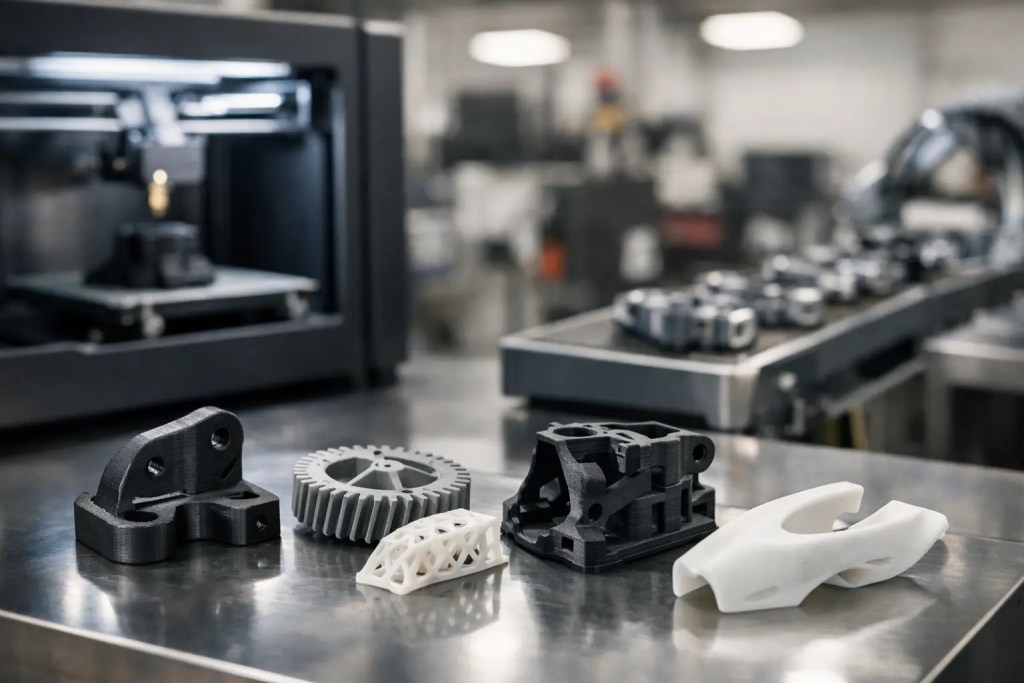
HP Multi Jet Fusion and SLS are commonly used for production polymer parts because they support strong, functional geometries with good repeatability and no support structures on most designs. Materials such as PA12 and PA11 are widely used for housings, clips, brackets, jigs, and end-use components where toughness and dimensional stability matter.
SLA can be valuable when fine detail and surface quality are priorities, but resin choice becomes critical because not all SLA materials are suitable for long-term functional use. FDM can be effective for larger functional parts, fixtures, and lower-volume industrial applications, though anisotropy and surface finish need to be managed carefully.
On the metal side, SLM enables production of complex aluminum and stainless steel components in materials such as AlSi10Mg and SS316L. This is especially relevant for lightweight structures, internal channels, consolidation of multi-part assemblies, and applications where machining every feature would be inefficient or impossible.
The key point is straightforward. You do not ask whether 3D printing works in general. You ask whether a specific process-material combination can meet the actual requirement.
Design for additive is what turns possibility into repeatability
Some parts print successfully once and still fail as production parts because the design was never optimized for process stability. Production-ready additive design is less about making exotic shapes and more about controlling outcomes.
Wall thickness, orientation, drainage, unsupported spans, powder escape, thermal behavior, and post-machining allowances all influence repeatability. Small changes in geometry can reduce distortion, improve yield, and make inspection easier. In production, that translates directly into more predictable lead times and fewer nonconformances.
This is where experienced manufacturing input matters. Engineers often begin with a CAD model designed around machining or molding assumptions. That file may still be manufacturable additively, but not necessarily at the best quality or cost. Reviewing the part for process fit before release is one of the most practical ways to avoid production issues later.
Quality control is the line between printing parts and manufacturing parts
This is the point many articles skip. Production is not defined by the printer. It is defined by the system around the printer.
A production workflow needs controlled file handling, machine calibration, validated materials, documented post-processing, inspection criteria, and traceability. Without that structure, additive remains a useful fabrication method but not a dependable production process.
For industrial buyers, quality systems matter because repeatability matters. ISO 9001:2015 certification does not guarantee that every geometry is suitable for additive, but it does signal that production is managed through documented procedures rather than ad hoc decisions. That is essential when parts move from one-off builds into ongoing supply.
Inspection planning should also be realistic. Not every additively manufactured part needs the same level of dimensional verification, but critical features should be identified early. If mating surfaces, holes, threads, or sealing faces are important, those features may require machining, tighter process controls, or dedicated checks after printing.
Trade-offs are real, and they should be evaluated early
Additive manufacturing offers clear advantages, but it is not exempt from engineering trade-offs.
Surface finish is one of the most common considerations. A printed part may perform perfectly well mechanically while still requiring vapor smoothing, bead blasting, machining, polishing, or coating to meet final-use expectations. Tolerances are another. Many printed parts are suitable for functional assemblies, but critical fits may need secondary machining or design allowances.
Lead time is usually favorable, especially when compared with tooling-based methods, but post-processing can affect total turnaround. Dyeing, heat treatment, support removal, machining, and inspection all need to be part of the production plan.
There is also the issue of consistency across technologies. Two processes may both produce a usable part, but one may offer better isotropy, tighter dimensional control, or lower finishing effort. Choosing correctly at the start prevents expensive qualification loops later.
Where 3D printed production parts make the most sense
The strongest production use cases are usually practical rather than flashy. Industrial housings, machine guards, mounting brackets, cable guides, airflow components, custom end-effectors, jigs, fixtures, and low-volume spare parts are frequent examples. So are metal parts with internal channels, lightweight lattice-supported features, or consolidated assemblies.
Customization is another area where additive becomes difficult to ignore. If each part needs a variation by customer, device model, or installation environment, traditional tooling can become a bottleneck. Additive allows design variation without resetting the entire production strategy.
This is why many teams now treat additive as part of the production mix rather than a separate prototyping silo. A product may begin with printed prototypes, move to short-run printed end-use parts, and later transition selected components to molding or CNC as demand stabilizes. A manufacturing partner with both additive and conventional capabilities can make that transition cleaner because the recommendation can follow the application, not the machine availability.
At Additive3D Asia, that production logic is central to process selection. The right answer may be MJF, SLS, SLA, FDM, metal SLM, CNC, urethane casting, or injection molding depending on the part, quantity, and performance target.
So, can 3D printed parts be production parts?
Yes, when they are treated like production parts from the beginning. That means selecting a qualified process, specifying the right material, designing for manufacturability, planning post-processing, and controlling quality with the same discipline you would expect from any industrial supply chain.
For engineering teams under pressure to shorten lead times without compromising performance, additive is no longer a side route. It is a viable production method when the application fits. The smartest next step is not asking whether 3D printing is real production. It is asking what your part needs in order to be manufactured reliably, repeatedly, and on schedule.