
A bridge production decision usually happens under pressure. Tooling is not ready, pilot demand is uncertain, and the commercial team still needs parts for testing, launch, or early shipments. That is where MJF vs injection molding bridge production becomes a practical manufacturing question rather than a theoretical one.
Bridge production sits between prototype and full-scale mass production. The goal is simple: get functional parts into the field quickly while controlling risk. The harder part is choosing the process that gives you the right balance of lead time, unit cost, part performance, and quality consistency. In most cases, the decision comes down to whether you need the speed and flexibility of HP Multi Jet Fusion or the repeatability and economics of molded parts.
What bridge production actually demands
Bridge production is rarely about finding the lowest possible piece price. It is about maintaining momentum while larger production decisions are still in motion. You may be validating demand, supporting regulatory or field testing, covering supply gaps, or shipping early customer orders before hard tooling is available.
That changes the decision criteria. A process that looks expensive on a spreadsheet can still be the right option if it removes weeks from the schedule. Likewise, a process with a low unit cost can be the wrong choice if tooling delays stall the program or if design changes are still likely.
For engineering and procurement teams, the best bridge production process is usually the one that absorbs uncertainty without compromising function. That means looking beyond part price and into setup time, change management, scrap risk, and post-processing requirements.
MJF vs injection molding bridge production: the core trade-off
MJF and injection molding solve different manufacturing problems.
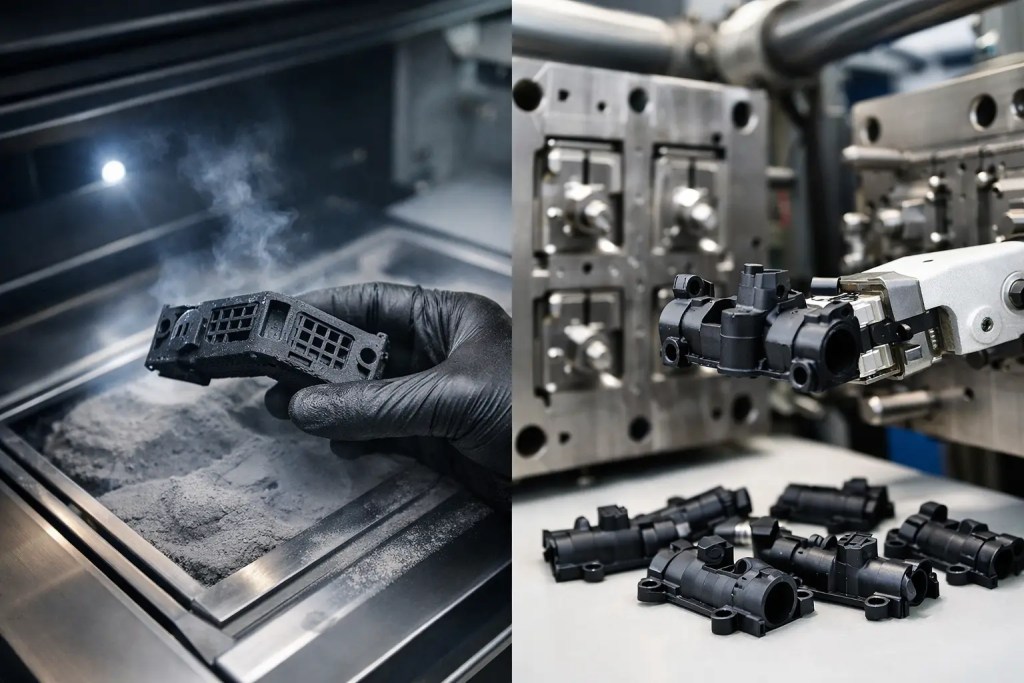
MJF is a powder-bed additive process that builds nylon parts directly from digital files, typically in materials such as PA12 or PA11. It removes the need for hard tooling, shortens startup time, and allows geometry changes with minimal disruption. That makes it particularly effective for short runs, iterative programs, and parts with complex internal or consolidated features.
Injection molding is a tooling-based process designed for repeatability and scale. Once the mold is complete and the process is dialed in, it delivers consistent part geometry, strong throughput, and very competitive per-part economics at higher volumes. It is the better fit when the design is stable and demand is large enough to justify tooling investment.
So the real comparison is not additive versus traditional manufacturing in general. It is digital flexibility versus tooling efficiency.
Where MJF has the advantage in bridge production
For most bridge programs, time is the first constraint. MJF performs well here because it starts from the CAD file rather than from a mold design and tool fabrication cycle. If the part is ready for production, manufacturing can begin as soon as the design, material, and quantity are approved.
That speed matters even more when designs are still evolving. If a snap fit needs adjustment, a wall section needs reinforcement, or a mounting feature changes after testing, MJF can absorb those updates without writing off tooling. In bridge production, design changes are common enough that this flexibility often has direct cost value.
MJF also enables part consolidation. Assemblies that would require multiple molded components can sometimes be combined into a single printed part. That can reduce fasteners, simplify inventory, and remove assembly labor. For low to medium bridge volumes, those savings may offset a higher nominal piece price.
Another practical advantage is inventory strategy. Because MJF is tool-less, production can be scheduled in smaller batches based on actual demand. Teams do not need to commit to large opening quantities to amortize tooling. That lowers exposure when forecasts are still noisy.
For functional bridge parts, MJF nylon is also a credible engineering material rather than a visual prototype material. PA12 and PA11 parts are regularly used for housings, covers, brackets, clips, jigs, and end-use components where mechanical performance, dimensional stability, and production-grade quality are required.
Where injection molding still wins
Bridge production does not automatically mean additive manufacturing. If your demand window is already substantial, your geometry is molding-friendly, and the design is frozen, injection molding may still be the better decision.
The biggest reason is cost at volume. Tooling creates an upfront investment, but once that is absorbed, molded part pricing usually drops far below printed part pricing. If your bridge requirement is large enough, the total landed cost can favor molding even before mass production begins.
Injection molding also offers advantages in cosmetic consistency, especially for consumer-facing parts with strict appearance standards. Surface texture, color matching, and repeatability across high quantities are well understood in molded production. MJF can deliver highly functional parts, and finishing can improve appearance, but if Class A visual requirements are central to the launch, molding often has a stronger case.
Material selection can also matter. While MJF covers many engineering use cases well, injection molding offers a broader universe of production thermoplastics, fillers, flame-retardant grades, and highly application-specific compounds. If your part depends on a very particular resin property set, molded production may align more closely with final manufacturing intent.
Volume is important, but it is not the only threshold
Many buyers want a simple crossover number for MJF vs injection molding bridge production. In practice, no single quantity decides the answer.
A relatively low-volume part with strict cosmetic requirements may justify molding earlier than expected. A higher-volume part with unstable geometry may still be better in MJF because the risk of tool changes is too high. The crossover depends on part size, geometry, finishing requirements, number of cavities, expected revisions, and how expensive delay would be to the program.
The better way to think about it is this: MJF tends to dominate when uncertainty is high and time matters most. Injection molding tends to dominate when demand is clearer, the design is fixed, and the program can support tooling lead time.
That is why bridge production decisions should be made at the project level, not by rule of thumb alone.
Design and quality considerations that affect the decision
Bridge parts still need to perform in the real world. That means process selection should be tied to the application, not just the schedule.
MJF parts generally offer strong functional performance, but they are built layer by layer and have process-specific design rules. Wall thickness, escape holes for powder removal, achievable detail, and surface finish all need to be reviewed. The process can produce excellent functional parts, but a part designed for molding is not always automatically optimized for additive production.
Injection molding brings its own design discipline. Draft angles, sink risk, gate location, ribbing strategy, and warpage control all influence manufacturability and tool complexity. A bridge part that seems simple can become expensive if the mold requires slides, lifters, or extensive tuning.
Quality planning matters in both cases. For bridge production, repeatability is often more valuable than theoretical capability. Teams need clear tolerances, stable workflows, and defined inspection criteria from the first batch onward. This is especially important when bridge parts support validation builds, field testing, or early commercial shipments.
An ISO 9001:2015-certified workflow can make a practical difference here because the process is not just fast – it is documented, controlled, and repeatable.
A smarter path is often sequential, not either-or
The most effective bridge strategy is often not choosing one process forever. It is choosing the right process for each phase.
A common pattern is to use MJF for early production while demand is being validated and design adjustments are still likely. Once the geometry is stable and the business case supports tooling, production can transition to injection molding. That reduces launch risk without forcing the team to wait for mold completion before shipping parts.
This phased approach also creates better data. Early field feedback from MJF parts can expose fit, durability, and user issues before those decisions are locked into steel. In many programs, that learning is worth more than the apparent savings of starting with molding too early.
For teams managing compressed timelines, a manufacturing partner with both additive and conventional production capability can simplify that handoff. Instead of treating bridge production as a separate sourcing problem, it becomes part of a controlled path from prototype to short-run manufacturing to scaled production.
How to choose with less guesswork
If you are evaluating MJF vs injection molding bridge production, start with five operational questions. How stable is the design? How many parts are actually needed before full production? What is the cost of waiting for tooling? How strict are the cosmetic requirements? And does the application depend on a resin or finish that strongly favors molding?
When design risk and schedule pressure are high, MJF usually gives the cleaner path. When volume, appearance, and long-run economics dominate, injection molding becomes harder to ignore. The right answer is often driven by the cost of change rather than the cost of the part.
For engineering teams, that is the useful framing. Bridge production is not just a temporary stopgap. It is a decision point that can either preserve program speed or introduce avoidable delays. Choose the process that keeps the product moving with the least operational risk, then transition when the data supports it.