
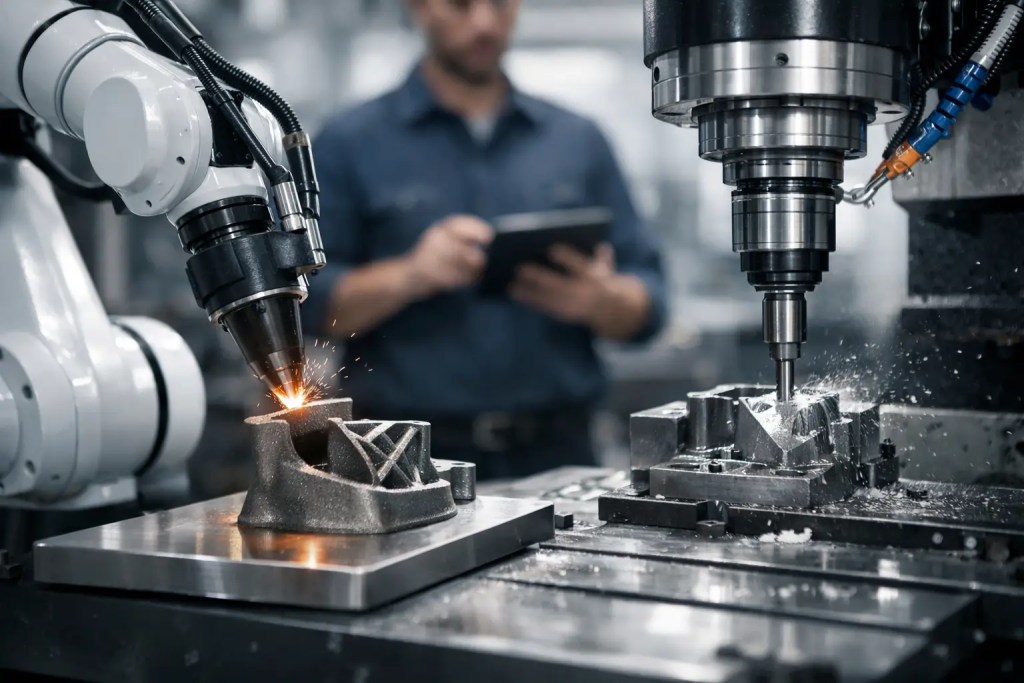
A prototype bracket passes fit checks on Monday, fails load testing on Tuesday, and needs machined datum surfaces by Wednesday so the next build can move forward. That is where hybrid manufacturing stops being a buzzword and becomes a practical production strategy. For engineering teams under schedule pressure, the value is simple: use additive where geometry and speed matter most, and use conventional processes where tolerances, surface finish, and cost efficiency matter more.
What hybrid manufacturing actually means
Hybrid manufacturing is the coordinated use of additive manufacturing and conventional fabrication within the same part, workflow, or product program. In practice, that can mean 3D printing a functional prototype and then CNC machining critical interfaces. It can mean validating geometry with SLS or MJF before moving a stable design into injection molding. It can also mean producing low-volume end-use parts with additive processes while secondary operations such as tapping, machining, bead blasting, anodizing, or laser marking bring the part to final specification.
The definition matters because the term is sometimes used too loosely. A machine that combines deposition and machining in one enclosure is one form of hybrid production, but most industrial buyers are solving a broader problem. They need a reliable path from concept to qualified part, and that path often spans multiple manufacturing methods. The real advantage comes from selecting each process for what it does best instead of forcing one method to do everything.
Why hybrid manufacturing is gaining ground
Lead time is the obvious driver, but it is not the only one. Product teams are under pressure to reduce iteration cycles without increasing supplier complexity. If one vendor can support polymer and metal additive manufacturing, CNC machining, molding, sheet metal work, and post-processing under a controlled quality system, the handoff risk goes down. Procurement gets fewer moving pieces, and engineering gets faster feedback on manufacturability.
There is also a cost reality. Pure additive is not always the right answer, especially as volumes increase or when parts require tight tolerances across multiple critical features. Pure conventional manufacturing is not always efficient either, particularly for complex internal channels, lightweighting features, or early-stage design changes. Hybrid manufacturing fits the middle ground where geometry, speed, performance, and unit economics have to be balanced rather than optimized in isolation.
Where the process mix creates the most value
The strongest hybrid workflows usually appear in three situations: development, bridge production, and end-use assemblies with mixed requirements.
Prototyping with production intent
In R&D, additive processes such as HP Multi Jet Fusion, SLS, SLA, FDM, and metal SLM reduce the time required to evaluate form, fit, and function. That part is well understood. The missed opportunity is stopping there. Many prototype programs fail because the printed part does not reflect the production-critical details that matter later, such as machined sealing faces, threaded inserts, controlled flatness, or cosmetic finishing.
A hybrid workflow closes that gap. A nylon prototype may be printed quickly to validate geometry, then machined in key areas to simulate final assembly conditions. A metal SLM component may be printed near net shape, then finished with CNC machining on bearing bores or mating surfaces. The result is more useful test data and fewer surprises when the design moves closer to release.
Bridge manufacturing before tooling
This is where hybrid manufacturing often delivers the clearest commercial benefit. A product is approved, demand exists, but tooling is not ready or volume is still uncertain. Additive can cover short-run needs immediately. Conventional processes can then be layered in selectively to improve finish, repeatability, or downstream assembly performance.
For example, MJF or SLS can produce functional housings in PA12 or PA11 for pilot builds, while machining, vapor smoothing, dyeing, or threaded hardware installation brings those parts closer to market-ready condition. If demand stabilizes and annual volume justifies it, injection molding can take over without discarding the learning from the additive phase. That transition is not a failure of additive. It is good manufacturing judgment.
End-use parts with different feature priorities
Some end-use components are natural candidates for a mixed process route. A part may have complex internal geometry that makes additive attractive, but it may also require precise bores, flat sealing faces, or post-machined threads. In metal, this is common with manifolds, brackets, heat-management parts, and lightweight fixtures. In polymers, it shows up in jigs, enclosures, ducting, and custom automation hardware.
The key point is that the process route should follow the functional requirements of each feature. Internal channels, weight reduction, and part consolidation may justify additive. Precision interfaces and wear surfaces may justify machining. Cosmetic or environmental requirements may justify coating or surface finishing. Hybrid manufacturing works best when those decisions are made early, not after defects or delays force a redesign.
Process selection in hybrid manufacturing
There is no universal recipe, but there is a disciplined way to make the call. Start with geometry, tolerance, material performance, expected volume, and downstream finishing requirements.
If the part benefits from design freedom, short lead times, and moderate mechanical performance, polymer additive is often the first lever. MJF and SLS are strong candidates for functional nylon parts where strength, consistency, and batch production matter. SLA makes sense when high detail or a smoother starting surface is needed, though the resin choice must match the actual mechanical and thermal requirement. FDM can be effective for large prototypes, fixtures, or budget-sensitive applications, but the anisotropy and surface quality have to be considered honestly.
For metal parts, SLM opens up geometries that are difficult or uneconomical to machine from billet. Still, near-net-shape metal additive rarely eliminates finishing. Critical interfaces usually need machining, and support removal, stress relief, and surface treatment may be part of the route from the beginning. That is normal, not a drawback.
Conventional processes enter when the design needs tighter tolerances, higher cosmetic consistency, or lower unit cost at larger volumes. CNC machining remains the standard for precision and predictable material behavior. Injection molding becomes more attractive when geometry is stable and demand can absorb tooling cost. Vacuum casting can fill the gap when appearance and short-run replication matter but hard tooling would be premature.
The trade-offs engineers should watch
Hybrid manufacturing is powerful, but it is not automatically simpler. Combining processes means managing interfaces between them.
Tolerance stack-up is one issue. A printed base geometry with machined secondary features can work very well, but only if the datum strategy is clear. If the printed surfaces are too variable to locate accurately for machining, the process route needs adjustment. Material behavior is another concern. PA12, PA11, AlSi10Mg, and SS316L all respond differently to heat, machining loads, and finishing steps. Choosing the right material is not separate from choosing the right process.
Volume crossover also matters. Teams sometimes stay with additive too long because it is convenient, then discover that unit economics no longer make sense. The opposite also happens. A team commits to tooling before design stability is proven and pays for revisions later. Hybrid manufacturing is effective because it keeps those options open, but only if someone is actively evaluating when the crossover point has changed.
Quality control matters more in a hybrid workflow
The more process steps involved, the more important process control becomes. This is one reason experienced buyers look for suppliers with formal quality systems and standardized workflows. It is not only about inspection at the end. It is about repeatable quoting assumptions, machine calibration, material traceability, revision control, post-processing discipline, and clear acceptance criteria at each stage.
An ISO 9001:2015-certified workflow adds structure to that handoff between additive and conventional operations. That is especially relevant for project-based manufacturing where parts may move from prototype to pilot to low-volume production in a short window. The engineering risk is lower when one manufacturing partner can control the transition rather than passing CAD, tolerances, and finish requirements across multiple vendors.
For teams trying to shorten procurement cycles, this matters almost as much as the process mix itself. A fast quote is useful. A fast quote backed by manufacturability guidance, material options, and a realistic production route is far more valuable.
When hybrid manufacturing is the right choice
If a project needs only one simple process, use one process. Hybrid manufacturing earns its place when the part or program has competing priorities: fast iteration but production-like testing, complex geometry but critical machined interfaces, uncertain demand but near-term delivery requirements, or low-volume customization with end-use reliability.
That is why the model fits modern product development so well. Most teams are not choosing between additive and traditional manufacturing in the abstract. They are trying to ship a qualified part on time, within budget, and without rebuilding the supply chain at every design stage. A hybrid approach gives them room to do that with more control.
For manufacturers such as Additive3D Asia that combine polymer and metal additive with CNC machining, molding, casting, sheet metal, and finishing under one operational workflow, hybrid manufacturing is less a trend than a practical service model. It reflects how real parts get made when engineering requirements are driving the decision.
The best manufacturing plan is rarely the one built around a favorite machine. It is the one that gets the part to specification with the least friction, the fewest avoidable risks, and a clear path from the next prototype to the next production run.