
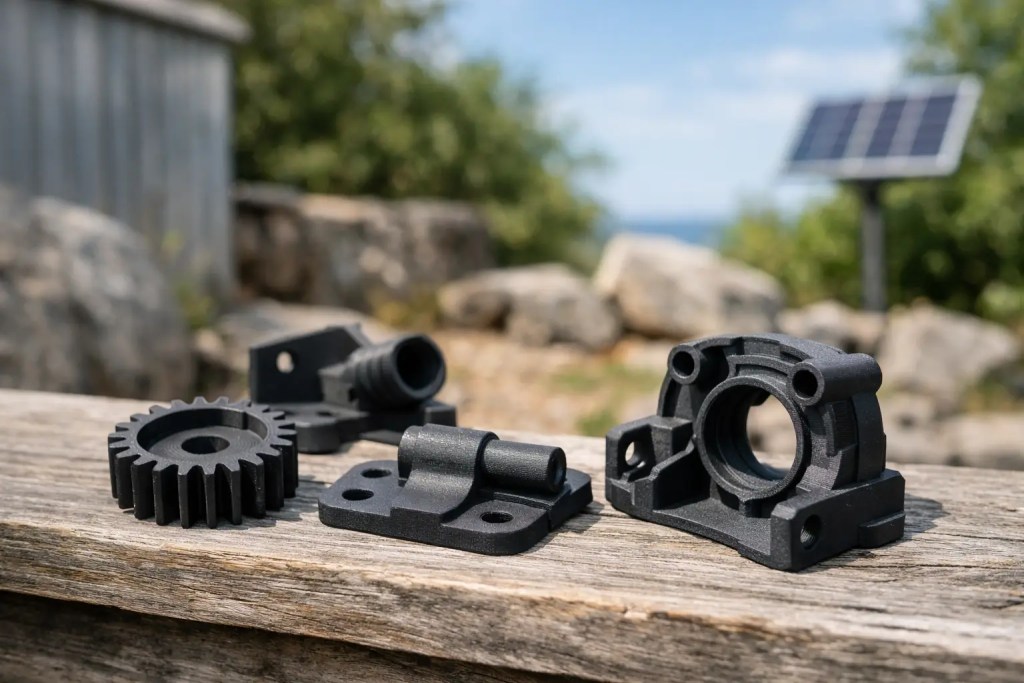
A PA12 enclosure mounted on outdoor equipment can look unchanged after months of rain yet lose impact resistance or show surface chalking after sustained sun exposure. That distinction matters when parts move from functional prototypes to installed hardware. So, can PA12 parts withstand outdoor use? Yes, in many applications, but only when UV exposure, temperature, loading, finish, and expected service life are evaluated as a system.
PA12 produced through HP Multi Jet Fusion or selective laser sintering is widely used for functional housings, brackets, cable-management components, guards, and low-volume end-use assemblies. It offers a useful balance of strength, toughness, chemical resistance, and low moisture uptake. However, standard PA12 should not be treated as an automatically weatherproof material. Outdoor performance depends on the actual environment and the consequences of failure.
Can PA12 Parts Withstand Outdoor Use in Practice?
For short- to medium-term outdoor deployment, PA12 is often a practical choice. Its low water absorption relative to other nylon grades helps it retain dimensional stability in humid or wet conditions. Rain and intermittent water exposure alone are rarely the primary limitation for a well-designed PA12 part.
Sunlight is usually the more demanding variable. Ultraviolet radiation can gradually alter the polymer surface, causing fading, chalking, and a reduction in ductility over time. A part may continue carrying a static load while becoming more likely to crack if struck or flexed. This is particularly relevant for clips, snap fits, thin covers, and brackets subject to vibration.
The answer also changes with the service definition. A temporary sensor housing used outdoors for several months is a different engineering case from a telecommunications enclosure expected to remain exposed for five years. Define the required service life before selecting the material and finishing route.
What PA12 Handles Well Outdoors
PA12 has several properties that make it a credible candidate for external equipment and field-deployed assemblies. It has good toughness, useful resistance to many oils and chemicals, and lower moisture absorption than PA6. For applications exposed to humidity, rain, washdown splash, or changing ambient conditions, this can reduce swelling and property variation.
Its additive manufacturing compatibility is equally valuable. MJF and SLS can produce complex ducting, lightweight lattice-supported structures, integrated cable routes, and consolidated assemblies without tooling. For low-volume production, that capability can shorten the path from design validation to field installation.
PA12 is also suitable where occasional thermal cycling occurs within its functional operating range. Still, engineers should distinguish between a material surviving a temperature excursion and maintaining stiffness, fit, and load capacity at that temperature. Under continuous load, elevated temperature can increase creep, especially in thin sections.
UV Exposure Is the Primary Outdoor Risk
Natural, unfinished PA12 is not the preferred choice for long-term direct sun exposure. UV radiation affects the exposed surface first, but degradation can progress over time. The practical result may be cosmetic change, surface embrittlement, or reduced durability under impact and cyclic stress.
Dark coloration can improve appearance retention and may help reduce UV transmission, but color alone is not a complete weatherability strategy. A black-dyed part is not necessarily UV-stabilized to the level required for multi-year outdoor service. Confirm the actual material specification and post-processing method rather than assuming that a dark surface provides guaranteed protection.
For parts exposed to intense sun, consider a protective coating system designed for polymer substrates. Paint or other qualified surface finishes can create a barrier against UV exposure while improving appearance and cleanability. Coatings introduce their own requirements: surface preparation, adhesion testing, film thickness control, edge coverage, and inspection must be managed consistently.
When an application requires a specific UV rating, long outdoor life, or regulated environmental performance, material selection should be supported by data from the intended production process. A generic PA12 datasheet may not represent the finished MJF or SLS component, particularly after dyeing, blasting, machining, or coating.
Design Factors That Decide Field Performance
Material selection alone does not determine whether a PA12 part succeeds outdoors. Geometry, loads, assembly conditions, and manufacturing orientation all influence durability.
Avoid sharp internal corners at mounting tabs, screw bosses, and transitions between thick and thin walls. These areas concentrate stress and can become initiation points for cracks after UV aging, vibration, or repeated thermal cycling. Use fillets, adequate wall thickness, and load paths that spread force across the component.
Fastener interfaces deserve particular attention. Directly tightening a metal screw into an unreinforced printed polymer boss can create local stress and long-term creep. Depending on the assembly, consider through-bolts with washers, metal inserts, clamping features, or redesigned joints that reduce sustained tensile stress. Torque requirements should be validated on production-representative parts.
Water management also matters. Although PA12 tolerates moisture well, trapped water can create secondary problems such as freeze-thaw loading, corrosion of adjacent hardware, or biological buildup. Add drainage paths, avoid upward-facing pockets, and protect sealing interfaces from rough, as-printed surfaces when water ingress is critical.
Temperature, Creep, and Thermal Cycling
Outdoor parts experience more than ambient air temperature. A dark component in direct sunlight can run substantially hotter than the surrounding environment. Equipment near motors, batteries, lighting, or process machinery may see additional heat from within the assembly.
At higher temperatures, PA12 becomes less stiff and more susceptible to creep under sustained loading. A bracket that performs well during a room-temperature bench test may slowly deflect in service if it supports a load under solar heating. Design with the maximum part temperature, not just the published ambient temperature, and include an appropriate safety factor for long-duration loading.
Thermal cycling can also affect assemblies made from different materials. Metal hardware and polymer housings expand at different rates. If a PA12 cover is tightly constrained by aluminum or steel components, repeated hot-cold cycles can increase stress around holes and edges. Clearance, compliant mounting features, and controlled fastener preload help manage this risk.
Selecting the Right Finish for Outdoor PA12 Parts
A finish should be selected according to the application, not only appearance. Bead blasting can provide a uniform matte surface but does not replace UV protection. Dyeing can improve color consistency, yet its weatherability must be verified for the required exposure. A qualified paint or coating system is often the better route where UV resistance and a controlled visual finish are both required.
For sealed enclosures, machining critical mating surfaces after printing may improve flatness and gasket performance. Vapor smoothing or other sealing-oriented finishing processes may also be considered where the process is compatible with the design and performance requirements. Any finish should be evaluated for dimensional impact, adhesion, chemical exposure, and compatibility with labels, gaskets, adhesives, and fasteners.
At Additive3D Asia, process selection can be aligned with the complete part requirement: additive manufacturing for complex geometry and fast iteration, followed by machining, coating, or conventional production methods when the final application demands tighter interfaces or increased environmental durability.
How to Validate PA12 for Outdoor Service
Do not rely on a visual assessment after a few days outside. Validate the part against the failure modes that matter to the assembly. This typically starts with a production-representative sample, including the intended orientation, finish, hardware, and post-processing route.
Accelerated UV and weathering tests can provide comparative evidence, but they should be paired with functional checks. Measure critical dimensions, inspect surfaces, and repeat the relevant mechanical test after exposure. For a latch, test retention force. For a bracket, test deflection and ultimate load. For an enclosure, check ingress resistance, gasket compression, and fastener torque retention.
Field trials remain valuable when the installed environment is unusually harsh. Coastal salt exposure, industrial chemicals, tropical humidity, desert UV, and high-vibration mobile equipment create different risks. A short field trial can expose installation and assembly issues that a material coupon test will not capture.
When PA12 Is Not the Best Choice
PA12 may not be the right answer for continuously sun-exposed components with a long required service life and no protective finish. It is also less suitable for high-temperature structural loads, applications requiring certified flame performance without a qualified formulation, or parts where zero creep is essential.
In these cases, a UV-stabilized polymer, reinforced engineering thermoplastic, coated component, or metal part may offer a more reliable path. The most efficient decision is not always to specify the strongest material. It is to choose the process-material-finish combination that meets the actual environment, load case, quantity, and lifecycle target.
For outdoor PA12, the best starting point is a clear service profile: expected years in the field, solar exposure, maximum part temperature, mechanical loading, chemical contact, and acceptable cosmetic change. With those requirements defined, PA12 can be engineered into a dependable outdoor component rather than treated as a material gamble.