
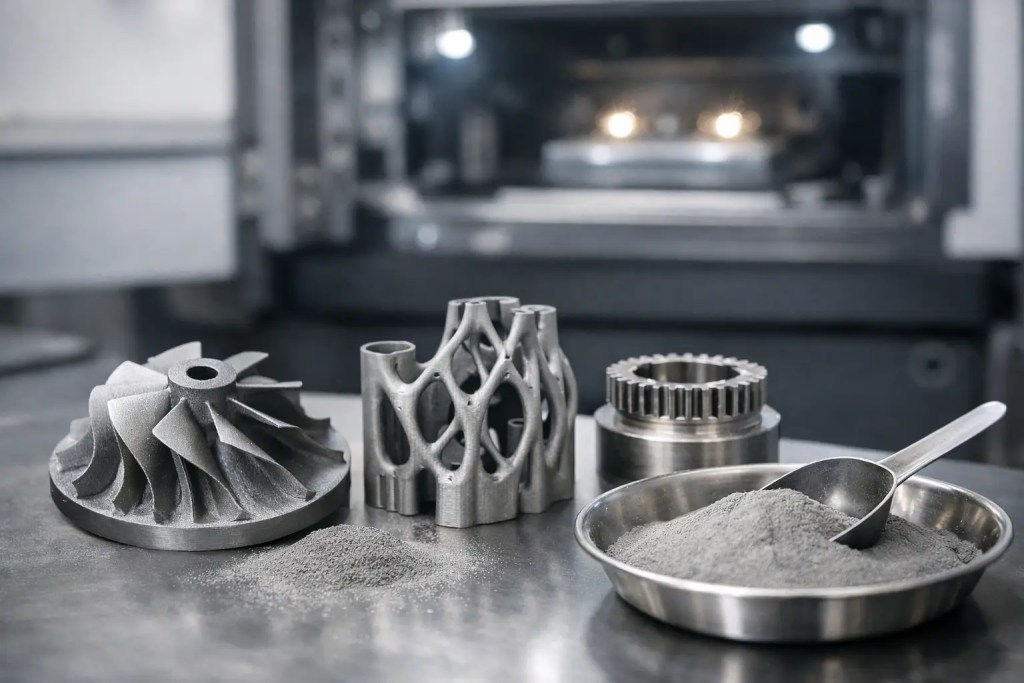
A material decision made before a CAD file reaches the build queue can determine whether a metal part becomes a reliable production component or an expensive iteration. This guide to metal additive manufacturing materials focuses on the practical engineering criteria behind alloy selection for laser powder bed fusion, commonly known as SLM: mechanical loading, operating temperature, corrosion exposure, geometry, post-processing, and qualification requirements.
Metal additive manufacturing does not make every alloy behave exactly as it would in bar stock, plate, or cast form. Parts are built layer by layer, with localized melting and rapid cooling. The result is a process-specific microstructure, directional properties, residual stress, and a surface condition that must be considered alongside the alloy datasheet. Material selection therefore begins with the part’s functional requirements, not with a preference for a familiar metal grade.
What Defines a Suitable Metal AM Material
For most engineering teams, the first question is not simply, “Which metal is strongest?” It is which material can meet the required performance with predictable manufacturing results. A high-strength alloy may add cost, require more demanding heat treatment, or increase the risk of distortion in a thin-walled design. A corrosion-resistant grade may be a better choice for a lower-load component that operates in wet, chemical, or marine environments.
Start by defining the load case, including static force, fatigue exposure, impact, wear, and stiffness. Then establish the environment: temperature range, moisture, salt spray, chemical contact, electrical conductivity, and biocompatibility where applicable. Finally, identify downstream operations such as machining, tapping, welding, polishing, coating, or heat treatment. These requirements narrow the material field quickly.
Build orientation and geometry also affect the decision. Thin sections, unsupported overhangs, internal channels, and large flat surfaces can influence residual stress, surface roughness, support strategy, and achievable tolerances. An alloy that prints well for a compact bracket may need a different process plan for a large pressure manifold or a lightweight lattice structure.
Guide to Metal Additive Manufacturing Materials by Alloy
Aluminum AlSi10Mg
AlSi10Mg is one of the most widely used aluminum alloys in metal additive manufacturing. It offers a practical balance of low weight, good strength, thermal conductivity, and corrosion resistance. It is a common choice for lightweight housings, brackets, heat-transfer components, automotive fixtures, and functional prototypes where reducing mass matters.
The material is well suited to complex geometries that would be difficult to machine from a billet, including conformal cooling channels and consolidated assemblies. Heat treatment can adjust mechanical properties, although engineers should account for possible dimensional movement after thermal processing. AlSi10Mg is not the default answer for every lightweight part. For highly polished cosmetic surfaces, very high-temperature service, or applications requiring specific wrought-alloy behavior, another material or manufacturing route may be more appropriate.
Stainless Steel 316L
SS316L is selected when corrosion resistance, toughness, and dependable general-purpose performance are central requirements. It is frequently used for fluid-handling components, industrial fixtures, marine-adjacent hardware, laboratory equipment, food-processing applications, and parts exposed to humid or chemically active environments.
Its value lies in versatility. SS316L can produce strong, dense parts and responds well to machining and common finishing operations. However, corrosion resistance depends on more than alloy selection. Surface roughness, crevices, trapped media, cleaning method, passivation, and operating chemistry all influence real-world results. For critical fluid or pressure applications, engineers should specify post-processing and inspection requirements early rather than treating them as secondary steps.
Stainless Steel 17-4PH
17-4PH stainless steel is a precipitation-hardening alloy used when higher strength and hardness are needed alongside useful corrosion resistance. Typical applications include tooling inserts, jigs and fixtures, mechanical components, shafts, and industrial hardware subject to repeated loading.
The material’s final properties are closely tied to its heat-treatment condition. That makes process control especially important: the design team should define the target condition, hardness range, and any machining allowance before production. Compared with 316L, 17-4PH is generally chosen for strength-driven applications rather than aggressive corrosion service. The correct choice depends on which requirement is less negotiable.
Tool Steels and Maraging Steel
Tool steels and maraging steels are designed for demanding mechanical service. Their high hardness, wear resistance, and heat-treatment response make them relevant for injection molding inserts, forming tools, dies, production fixtures, and wear-prone components. Additive manufacturing is particularly useful when a tool requires conformal cooling channels that follow the shape of a molded part rather than the straight-line paths possible with conventional drilling.
The trade-off is that these materials require disciplined post-processing. Stress relief, heat treatment, machining of critical faces, and surface finishing are often part of the production route. A printed tool can reduce cycle time or consolidate complex cooling geometry, but it should be evaluated as a complete manufacturing system, not as a direct substitute for a conventionally machined block.
Titanium Ti6Al4V
Ti6Al4V combines a high strength-to-weight ratio with excellent corrosion resistance and biocompatibility. It is used for aerospace components, motorsport parts, medical devices, chemical-processing hardware, and performance-driven assemblies where mass reduction carries significant value.
Titanium is most compelling when its premium cost is justified by function. A lightweight flight-ready bracket, patient-specific implant, or consolidated fluid component can benefit from its properties and design freedom. For a low-cost fixture or standard industrial enclosure, aluminum or stainless steel may provide a more economical result. Titanium parts also require careful support removal and may need machining on precision interfaces, threads, and sealing surfaces.
Nickel Alloys: Inconel 625 and 718
Nickel-based superalloys are selected for elevated-temperature and corrosive environments beyond the practical range of aluminum, standard stainless steels, and many tool steels. Inconel 625 provides strong corrosion and oxidation resistance, while Inconel 718 is commonly used where high-temperature strength and fatigue performance are priorities.
These materials are relevant to aerospace, energy, process equipment, and high-heat tooling. They are also more costly and more challenging to machine than common steels or aluminum. Use them when the service environment requires their performance, not as an insurance policy against undefined requirements. If operating temperature, pressure, and media are not clearly documented, the material choice is still premature.
Match Post-Processing to the Functional Surface
As-built metal AM surfaces are not equivalent to machined surfaces. The exact finish depends on alloy, machine parameters, orientation, and part geometry, but critical interfaces commonly require secondary operations. Machining is appropriate for bores, threads, bearing seats, sealing faces, and precision datums. Bead blasting can provide a more uniform appearance, while polishing may be required for flow paths, cosmetic surfaces, or applications where lower roughness is functional.
Heat treatment and stress relief should be planned at the quotation and design stage. They can improve performance and reduce internal stress, but they can also affect dimensions. For tight-tolerance features, a reliable workflow often includes printing with machining stock, thermal processing, then finish machining to final dimensions. This sequence is more controllable than expecting every critical dimension to emerge directly from the build.
Design Specifications That Prevent Material Mismatch
A clear specification reduces avoidable iterations. Include the intended alloy, target mechanical properties where applicable, heat-treatment condition, critical tolerances, surface-finish requirements, inspection needs, and the operating environment. If a part will be pressure tested, exposed to saltwater, installed near a heat source, or used in a fatigue-sensitive assembly, state it explicitly.
It also helps to separate features by function. Not every surface needs machining, and not every region requires the same finish. Defining critical interfaces allows the manufacturing plan to focus cost and inspection effort where they affect performance. This is especially valuable for short-run production, where a well-defined process route supports consistency from the first part through subsequent orders.
For teams moving from prototype to end-use production, material selection should be reviewed again at each stage. A prototype may prioritize speed and basic function. A production part may require a documented heat-treatment route, tighter inspection, traceability, and a finish that supports long-term service. Additive3D Asia can support this transition by combining metal SLM with machining, finishing, and complementary manufacturing processes under a controlled workflow.
The most effective material choice is rarely the alloy with the most impressive datasheet. It is the one that meets the actual load, environment, geometry, finish, and production requirements with a process plan your team can repeat confidently.