
A prototype that looks right but fails under load is expensive. A part that meets strength targets but arrives late can be just as costly. That is where industrial 3d printing separates itself from desktop output and visual mockups. For engineering teams, the real value is not novelty. It is getting functional parts, repeatable quality, and a production path that holds up when timelines tighten.
What industrial 3d printing actually means
Industrial 3d printing refers to additive manufacturing systems, materials, and workflows designed for engineering use rather than hobby use. The difference shows up in three places: machine capability, material performance, and process control.
At the machine level, industrial platforms deliver tighter thermal control, better dimensional consistency, and higher throughput. At the material level, you are working with engineering polymers and metals selected for specific requirements such as stiffness, impact resistance, heat resistance, or corrosion performance. At the workflow level, the process includes traceable file handling, orientation strategy, support planning, post-processing, and inspection.
That distinction matters because most commercial parts are judged by outcomes, not by how they were made. If a fixture must hold tolerance on the line, or a duct must survive elevated temperatures, the manufacturing method has to support that requirement consistently.
Where industrial 3d printing fits in the product lifecycle
The strongest use case for industrial 3d printing is not limited to early concept work. It is effective across several stages of development and production, provided the part geometry and business case are right.
In prototyping, additive manufacturing shortens iteration cycles because geometry changes do not require new tooling. Engineers can test form, fit, and function in days instead of waiting for mold fabrication or extensive machining setup. That speed is useful, but the bigger advantage is decision quality. Teams can validate assemblies, mounting features, airflow paths, and ergonomic factors with physical parts before committing to downstream production.
In bridge production and short-run manufacturing, industrial additive becomes even more practical. Low-volume parts, custom variants, and service components often do not justify tooling investment. A printed PA12 enclosure, SS316L bracket, or AlSi10Mg housing can meet performance needs while reducing procurement friction.
For end-use parts, the threshold is higher. The application must account for process capability, anisotropy, surface finish, inspection requirements, and cost at target volume. When those variables are understood, additive can be the better manufacturing route, especially for lightweight structures, internal channels, consolidated assemblies, and low-to-medium production quantities.
Choosing the right process for the job
Process selection is where many projects either gain momentum or lose time. Industrial 3d printing is not one technology. It is a family of processes with different trade-offs.
Polymer systems for functional parts
HP Multi Jet Fusion is often a strong choice for functional polymer parts when you need good mechanical properties, repeatability, and production-friendly throughput. PA12 is widely used for housings, brackets, clips, covers, and jigs because it balances strength, dimensional stability, and chemical resistance. PA11 can be a better fit when ductility and impact performance matter more.
SLS also serves functional nylon parts well, particularly for complex geometries and nested builds. It remains a dependable option for prototypes and low-volume production when design freedom is a priority.
SLA is different. It excels in surface quality, fine detail, and visual accuracy. That makes it useful for presentation models, master patterns, and selected functional prototypes. The limitation is that resin behavior varies widely, and not every SLA material is suitable for long-term mechanical use.
FDM has its place, especially for larger components, fast concept parts, and cost-sensitive fixtures. It is practical, but it typically involves more visible layer lines and process-dependent surface variation than powder-bed polymer systems.
Metal additive for high-value applications
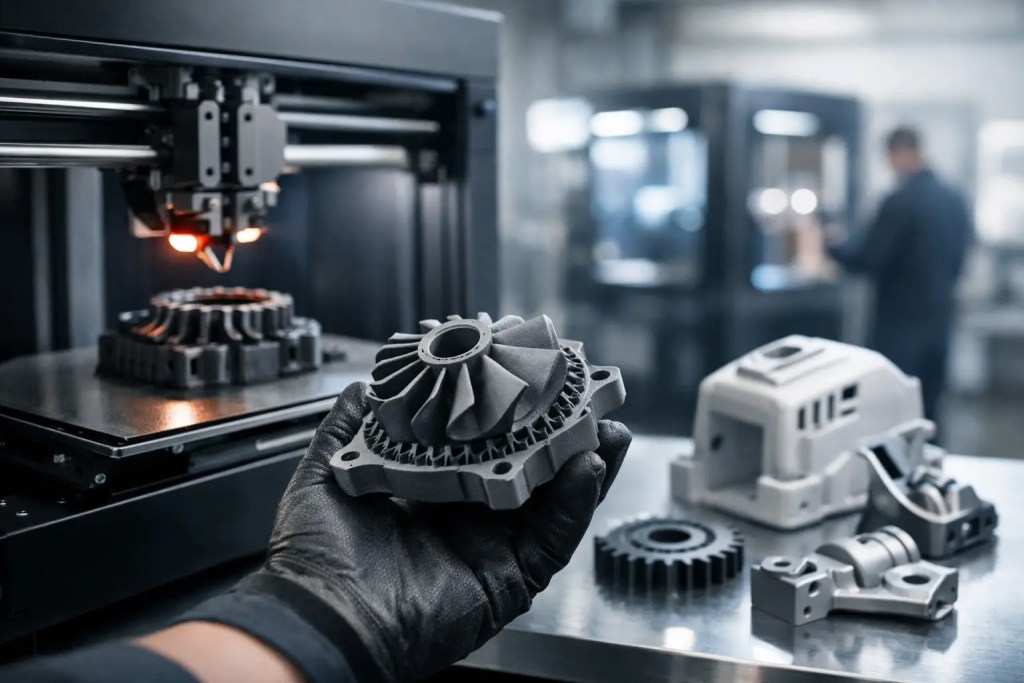
Metal SLM is used when the part benefits from geometry that conventional machining cannot produce efficiently. Lightweight lattice structures, internal cooling channels, and part consolidation are common examples. Materials such as AlSi10Mg and SS316L support applications in tooling, industrial equipment, and specialized end-use assemblies.
The trade-off is that metal additive requires stricter process planning and post-processing. Support removal, heat treatment, machining of critical interfaces, and inspection all shape the final result. For this reason, the best metal additive programs are engineering-led from the beginning.
Why industrial 3d printing succeeds or fails in production
The process alone does not guarantee production success. Most problems come from using the wrong technology for the part requirement or treating additive as a file-to-part shortcut without manufacturability review.
A strong additive workflow starts with the application. Is the part structural, cosmetic, thermal, wear-related, or assembly-critical? What tolerance bands actually matter? Which surfaces need finishing? Does the part need to withstand repeated loading, UV exposure, or chemicals? These questions narrow the process quickly.
Orientation strategy is another major factor. A part printed flat may build faster, while a different orientation may improve strength in the required axis or reduce support marks on critical surfaces. Build packing also affects throughput and consistency, particularly in batch production.
Post-processing should be planned, not treated as cleanup. Dyeing, vapor smoothing, bead blasting, machining, tapping, inserts, and surface coatings can move a part from prototype-grade to production-ready. If those steps are considered early, the printed geometry can be designed to support them.
Finally, quality systems matter. For engineering teams and procurement managers, repeatability is not a marketing phrase. It is the difference between a supplier that can support ongoing production and one that can only provide occasional samples. Standardized workflows, documented inspection, and controlled process parameters reduce variation and make scaling possible.
Industrial 3d printing versus conventional manufacturing
The right question is rarely additive or traditional. In practice, it is additive first, then the best downstream process as volumes and requirements evolve.
For low volumes, complex geometry, and rapid iterations, industrial 3d printing usually has the advantage. There is no tooling delay, setup time is reduced, and design revisions are easier to absorb. That makes it especially effective for product development, spares, custom devices, and bridge manufacturing.
For higher volumes of stable geometry, injection molding often wins on unit economics. CNC machining remains a better fit for certain tight-tolerance metal parts, especially when the geometry is simple and stock removal is straightforward. Sheet metal fabrication is still the efficient path for many enclosures and brackets.
This is why many engineering teams prefer a manufacturing partner that can support both additive and conventional processes. The benefit is not just convenience. It allows the part to move through the most appropriate production route without vendor fragmentation or repeated quoting cycles.
What engineers should evaluate before ordering
A good additive part starts with a clear requirement set. The key inputs are simple but specific: function, environment, target quantity, acceptable tolerance, finish expectation, and delivery timeline.
If a part needs snap-fit behavior, that points toward different materials than a rigid inspection fixture. If the component sits near a motor or heated chamber, thermal performance matters more than cosmetic finish. If mating features require precision, you may print the core geometry and machine the critical surfaces afterward.
Lead time should also be viewed realistically. Printing is fast, but the total schedule includes file review, build preparation, printing, cooling, depowdering or support removal, finishing, and inspection. On urgent jobs, the supplier’s workflow discipline is often more important than the printer model itself.
This is where an engineering-first service bureau adds value. A team that can assess STL or STEP files, flag risk areas, recommend a more suitable process, and manage finishing in-house reduces rework and shortens procurement loops. Additive3D Asia, for example, positions this around ISO 9001:2015-controlled workflows, multi-process coverage, and an instant-quote path that helps teams move from CAD to approved production faster.
The practical value of industrial 3d printing
Industrial 3d printing is most useful when speed, complexity, and controlled quality need to exist at the same time. It is not the answer to every manufacturing problem, and it should not be sold that way. Some parts belong in molds, some belong on mills, and some only make financial sense once they are redesigned for a different process.
But when the application is right, additive does more than save time. It reduces design compromise, compresses validation cycles, and gives teams a viable route from prototype to short-run production without rebuilding the supply chain around every revision.
The best results come from treating additive as a manufacturing decision, not just a printing service. Start with the function, select the process around the requirement, and choose a partner that can hold quality steady when the project moves beyond the first sample.