
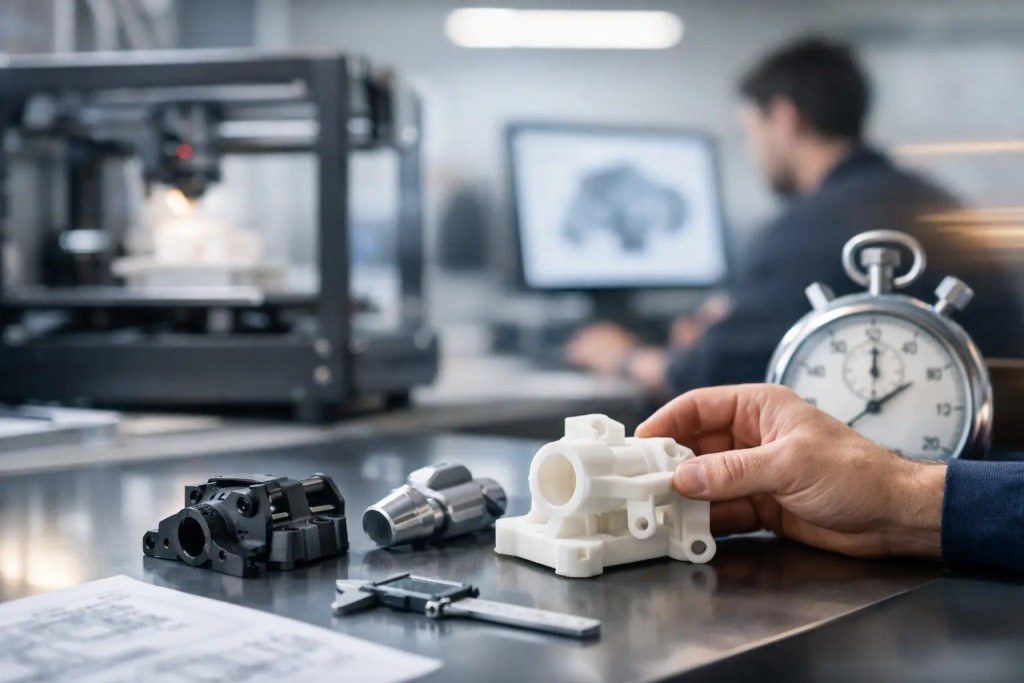
A prototype that arrives three days late can push testing, purchasing, and design freeze by weeks. That is why engineers keep asking how to reduce prototype lead times without creating new risk in quality, fit, or performance. The answer is rarely a single faster machine. Lead time is usually lost in handoffs, unclear requirements, avoidable redesigns, and process mismatches long before production starts.
How to reduce prototype lead times starts before production
Most delays are decided upstream. If the CAD model is incomplete, tolerances are inconsistent, or the material callout does not match the actual use case, the clock starts running before any part is built. A fast manufacturing partner can shorten fabrication time, but it cannot fully recover time lost to preventable engineering uncertainty.
The practical fix is to treat prototype speed as a design control issue, not just a supplier KPI. Start with a clear definition of what the prototype must prove. If the part only needs to validate form and assembly, do not specify an end-use metal process with cosmetic finishing. If it needs functional load testing, do not send a visual mockup file and expect production-grade results. Matching the prototype objective to the right process avoids the most common source of delay: ordering a part that is overbuilt for the stage of development.
This is where disciplined design review matters. Engineers who reduce lead times consistently tend to lock three things early: required tolerances, critical surfaces, and performance criteria. Everything else can stay flexible. That gives the manufacturer enough information to recommend a process quickly without weeks of clarification.
Reduce quoting friction and approval delays
A surprising amount of prototype lead time disappears in procurement rather than fabrication. Files are sent by email, revisions are mixed up, material options are discussed across separate threads, and purchase approvals wait for incomplete quotes. By the time production is approved, the actual machine time may only be a small fraction of the total elapsed time.
To reduce that delay, standardize what gets submitted with every RFQ. A clean STEP or STL file, part quantity, target material, required finish, tolerance notes, and delivery deadline should be the minimum package. If there is a non-negotiable functional requirement such as heat resistance, thread strength, watertightness, or inspection reporting, state it upfront. Manufacturers can move faster when the commercial and technical requirements arrive together.
Instant-quote workflows help because they remove unnecessary back-and-forth at the front end. They are especially useful when product teams are comparing multiple routes such as MJF versus SLS for nylon parts, or SLA versus CNC for detail and surface requirements. The gain is not just speed. It is cleaner decision-making. When pricing, process, and manufacturability guidance appear in the same workflow, fewer projects stall between engineering and purchasing.
There is a trade-off here. Fully automated quoting is excellent for straightforward parts, but complex geometries, metal builds, or assemblies with tight interfaces may still need engineering review. The fastest path is not always zero human involvement. It is the right level of review at the right stage.
Choose the manufacturing process that fits the prototype objective
Process selection has more impact on lead time than many teams expect. A part can be technically manufacturable in five different ways and still be slow because the chosen method creates unnecessary programming, tooling, or finishing work.
For polymer prototypes, additive manufacturing often removes the setup delays that come with machining or molding. HP Multi Jet Fusion and SLS are strong choices for functional nylon components where speed, good mechanical performance, and no tooling are priorities. SLA is better when visual quality, fine details, or smooth surfaces matter more than isotropic strength. FDM can be efficient for larger, simpler concept models, fixtures, or early-stage functional checks when surface finish is not the main concern.
For metal parts, the decision is more situational. Metal SLM can accelerate complex geometries that would be difficult to machine conventionally, especially when internal channels or weight reduction matter. But if the prototype is a simple block-like geometry with tight tolerances on machined faces, CNC may still be faster and more economical. The same logic applies to short-run bridge needs. If a prototype is trending toward low-volume production, vacuum casting or urethane casting may reduce total program time by supporting multiple iterations without committing immediately to hard tooling.
The key point is simple: do not ask one process to solve every prototype problem. Teams that move faster select the process based on what needs to be learned from the part, not on habit.
Design for manufacturability is the fastest schedule lever
If you want a direct answer to how to reduce prototype lead times, design for manufacturability is usually it. Small CAD decisions create large downstream effects. Wall thicknesses that are too thin for the chosen process, unsupported overhangs, enclosed powder traps, unnecessary cosmetic features, and unrealistic tolerance stacks all trigger revisions or post-processing that extend turnaround.
A manufacturability review should happen before the order is placed, not after the machine queue is assigned. This review does not need to be bureaucratic. It needs to be targeted. Check whether the geometry matches process limits, whether tolerances are applied only where function requires them, whether threaded features should be printed or machined, and whether surfaces that matter to fit are clearly identified.
This is especially important when teams are moving from prototype to pilot builds. A part that works once in a lab may still be slow to manufacture repeatedly. Design choices that support repeatability tend to support faster lead times too. Standard hole sizes, accessible datum features, realistic surface specs, and simplified assemblies all reduce friction.
Consolidate suppliers to remove handoff delays
Prototype schedules often slip because one vendor prints the part, another machines secondary features, and a third handles finishing or casting. Each transfer adds queue time, communication risk, shipping delay, and revision control issues. Even when each supplier performs well individually, the total schedule becomes harder to control.
A one-stop manufacturing model shortens lead times because process transitions are managed within a single workflow. If a nylon prototype needs printed geometry, machined mating surfaces, and cosmetic post-processing, coordination is simpler when those capabilities are aligned under one quality system. The benefit is operational, not just administrative. Engineering intent is preserved more consistently when fewer organizations reinterpret the same part.
This matters even more for teams working globally. Centralized quality control, documented workflows, and defined turnaround windows create schedule predictability that ad hoc vendor networks rarely match. For companies balancing R&D speed with procurement accountability, that predictability is often worth more than saving a day on one isolated operation.
Build speed into iteration planning
The fastest prototype programs do not assume the first build will answer every question. They plan iteration deliberately. That means breaking the program into learning cycles: geometry check, assembly validation, functional testing, then production-readiness refinement. Trying to combine all four into a single perfect prototype usually increases lead time because every requirement becomes critical at once.
There is a practical scheduling advantage here. Early rounds can use faster materials or processes to answer limited questions, while later rounds move into tighter tolerances or production-intent materials. For example, an enclosure may begin as a quick polymer build for fit and user handling, then move to a higher-fidelity process once the geometry is stable. The total calendar time is often shorter than waiting for one all-in prototype that attempts to do everything.
This staged approach also improves communication with your manufacturing partner. When the team knows which dimension is critical now and which can wait until the next round, production decisions become faster and more defensible.
Use quality systems to move faster, not slower
Some teams assume formal quality control adds time. In practice, poor quality adds more. Rebuilds, dimensional surprises, mislabeled revisions, and undocumented substitutions are among the most expensive forms of delay. An ISO 9001:2015-certified workflow helps reduce those risks by standardizing file handling, process control, inspection discipline, and traceability.
That does not mean every prototype needs the same level of documentation. It means the workflow should be consistent enough that urgent projects do not become chaotic projects. The right partner balances speed with controls that prevent avoidable mistakes. Additive3D Asia takes this approach by combining instant quoting, broad in-house process coverage, and standardized production workflows so engineering teams can move quickly without losing manufacturing discipline.
If lead times are still longer than expected, the answer is usually in the process around the part. Cleaner inputs, better process selection, fewer supplier handoffs, and tighter iteration planning will outperform last-minute expediting almost every time. The fastest prototype is the one that was easy to quote, easy to make, and clear about what it needed to prove.