
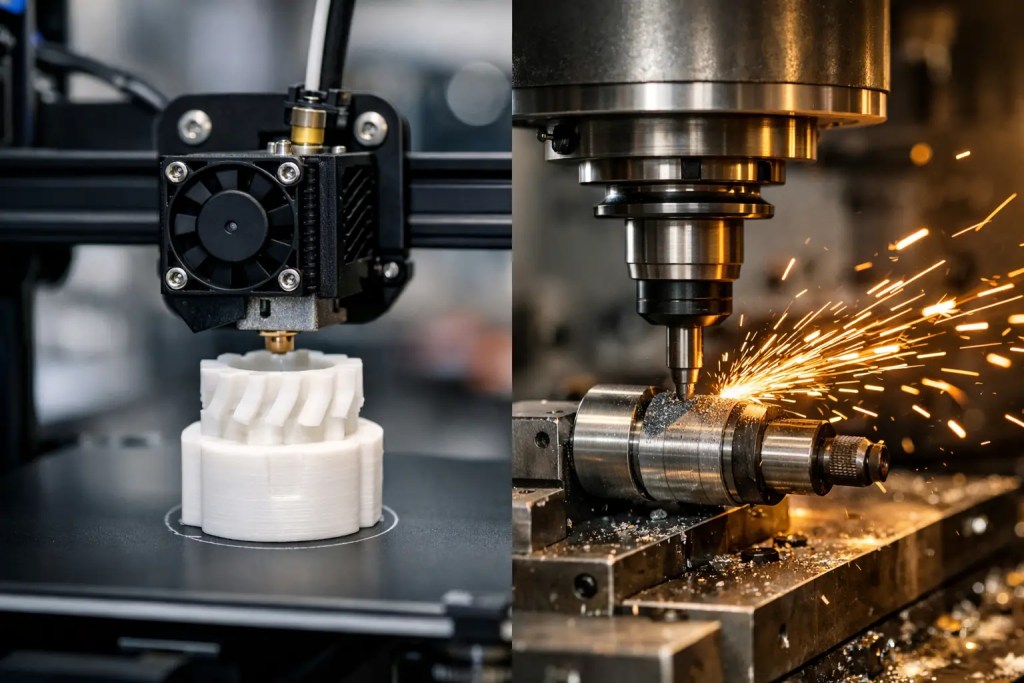
A machined aluminum bracket can be cost-effective at 5,000 units and completely uneconomical at 5. A molded housing can deliver the lowest unit price in production, yet become the most expensive choice if you are still changing wall thicknesses every week. That is why the real answer to is 3d printing cheaper than traditional manufacturing? is not yes or no. It depends on volume, geometry, lead time, material requirements, and how much design change your program still has ahead of it.
For engineering and procurement teams, cost is rarely just the quoted part price. It includes tooling, programming, setup, scrap risk, supplier coordination, inventory exposure, and the cost of waiting. When those factors are measured together, additive manufacturing is often cheaper in prototyping, bridge production, and complex low-volume parts. Traditional manufacturing usually becomes cheaper when designs are stable and quantities are high enough to spread fixed costs efficiently.
Is 3D printing cheaper than traditional manufacturing at low volumes?
In low-volume production, 3D printing often has a clear cost advantage because it removes tooling and reduces setup overhead. A part produced in PA12 with Multi Jet Fusion or SLS can go from CAD to production without mold fabrication, custom fixtures, or extended machine setup. That matters when you need 1 part, 20 parts, or a few hundred parts quickly.
Traditional processes carry fixed costs that do not shrink just because the order is small. CNC machining requires programming, workholding, machine time, and often more operator involvement per part. Injection molding is even more sensitive to volume because the mold cost has to be absorbed across the production run. If the mold costs $8,000 to $20,000 or more, a short run can become expensive very quickly.
This is where additive manufacturing changes the economics. If your part is still in validation, your demand is uncertain, or your team wants to avoid committing capital to tooling, 3D printing can lower both direct cost and financial risk. The shorter lead time also reduces the cost of design delays, which is often more significant than the manufacturing quote itself.
When traditional manufacturing becomes cheaper
Once volumes rise and geometry is suitable, traditional manufacturing usually wins on per-unit economics. Injection molding is the clearest example. After the tooling is built, cycle times are fast, labor per part is low, and material cost is efficient. For stable polymer parts in the thousands or tens of thousands, molding generally outperforms 3D printing on unit cost.
The same logic applies to CNC machining for certain metal and plastic components. If the geometry is straightforward, tolerances are well defined, and the process can be repeated with efficient fixturing, machining can produce parts at lower cost than metal additive or high-detail polymer printing. Sheet metal fabrication also becomes more economical when the design matches standard bends, cut features, and production workflows.
The breakpoint is not universal. It changes with part size, complexity, material, tolerance, finish, and whether post-processing is required. A simple enclosure may favor injection molding quickly. A complex internal duct, lightweight lattice structure, or consolidated assembly may remain more cost-effective with additive even at higher volumes.
The cost drivers that matter most
Tooling is the first major divider. Additive manufacturing has little to no hard tooling cost, which makes it economical for prototypes, custom parts, and short runs. Traditional methods often require molds, fixtures, dies, or dedicated setups that increase the entry cost before the first acceptable part is made.
Geometry is the second. Complexity is usually cheap in 3D printing and expensive in traditional manufacturing. Internal channels, undercuts, organic forms, and part consolidation can be produced additively with less penalty than they would face in machining or molding. In traditional production, each added feature can mean more toolpaths, more setup changes, more assembly steps, or more expensive tooling.
Labor and process steps are the third. A printed part may require depowdering, support removal, machining of critical features, or surface finishing. A machined or molded part may need less finishing, depending on the design. The cheaper option is the one that delivers the required performance and finish with the fewest total steps, not necessarily the one with the lowest raw build cost.
Lead time also has a direct cost impact. If one process delivers parts in days and another takes weeks due to tooling or queue time, the slower route may cost more through delayed testing, delayed launch, or extended engineering cycles. For R&D teams and hardware startups, time-to-decision often matters as much as part price.
Part complexity changes the answer
If you compare a basic rectangular block, 3D printing may look expensive next to machining. But that comparison misses where additive creates value. The economics improve when a part is difficult to machine, impossible to mold without expensive tooling, or currently assembled from several components.
Part consolidation is a practical example. If an assembly of six components can be redesigned into one printed part, you may reduce fasteners, sourcing complexity, tolerance stack-up, inspection effort, and assembly labor. The printed part may cost more than any one individual component, but less than the total system cost.
This is particularly relevant for jigs, fixtures, end-of-arm tooling, ducting, housings, brackets, and custom machine components. In those applications, additive manufacturing often produces a better cost outcome because the design is specific, the volumes are modest, and the value of fast iteration is high.
Material and quality requirements can shift the economics
Material choice matters because not every part can move freely between additive and traditional processes. A PA12 functional prototype, an SLA cosmetic model, an AlSi10Mg lightweight metal part, and an SS316L corrosion-resistant component all behave differently in production and post-processing.
If the part needs very tight tolerances, critical machined interfaces, or a surface finish that requires secondary operations, the apparent cost advantage of 3D printing can narrow. On the other hand, if the material and process already meet the performance target with minimal finishing, additive can remain highly competitive.
This is why process selection should be application-driven, not technology-driven. An engineering team should ask whether the part needs isotropic mechanical performance, heat resistance, smooth cosmetic surfaces, certification traceability, or end-use durability. The cheapest route is the one that meets those requirements without overprocessing the part.
Is 3D printing cheaper than traditional manufacturing over the full product lifecycle?
Across the full product lifecycle, 3D printing is often cheaper early and traditional manufacturing is often cheaper later. During concept development and validation, additive reduces design iteration cost because changes are made in CAD, not in hard tooling. That makes it highly effective for form-fit-function testing, pilot builds, and pre-production evaluation.
As demand stabilizes, the economics may shift toward CNC machining, vacuum casting, or injection molding. A well-managed manufacturing strategy does not treat these as competing camps. It uses additive for speed and flexibility where those matter most, then transitions to conventional methods when volumes and design maturity justify it.
That is why many teams benefit from a manufacturing partner that covers both additive and traditional processes under one quality framework. Instead of forcing the part into a single method, the process can follow the program stage. A supplier with ISO 9001:2015 controls, material breadth, and in-house production options can help identify the crossover point with less procurement friction and fewer quality surprises.
How to decide which process is cheaper for your part
Start with quantity, but do not stop there. The better question is how many parts you need before the design is frozen, how complex the geometry is, what tolerances are critical, what finish is required, and how expensive delay would be to your project.
If you need a small batch fast, expect changes, or want to avoid tooling exposure, 3D printing is often the cheaper option. If you need repeatable production at scale for a stable design, traditional manufacturing usually takes over. Between those endpoints, hybrid paths such as printed prototypes, cast bridge parts, and molded production parts often deliver the best cost structure.
At Additive3D Asia, this is typically where engineering support matters most: matching geometry, material, and volume to the right process instead of assuming one method is always cheaper.
The useful question is not whether additive beats traditional manufacturing in every case. It is whether your current stage, part design, and delivery target justify the trade-offs. When you price the whole job, not just the part, the right answer gets much clearer.