
When a prototype works but production still fails
A functional prototype can give a false sense of readiness. The geometry is validated, the assembly fits, and early testing looks good. Then production starts and the real constraints show up – inconsistent lead times, tooling costs that do not make sense at low volumes, and part variation that creates downstream issues in assembly or field use.
That is where an MJF production parts case study becomes useful. Not as marketing shorthand, but as a manufacturing decision framework. For engineers and procurement teams, the value is not simply that HP Multi Jet Fusion can print nylon parts quickly. The real question is whether it can deliver repeatable, production-grade components with enough process control to support actual deployment.
For many low- to mid-volume programs, the answer is yes. But only if the application fits the process, the material is selected for the actual load case, and the supplier operates with production discipline rather than prototype-shop habits.
The production problem MJF is meant to solve
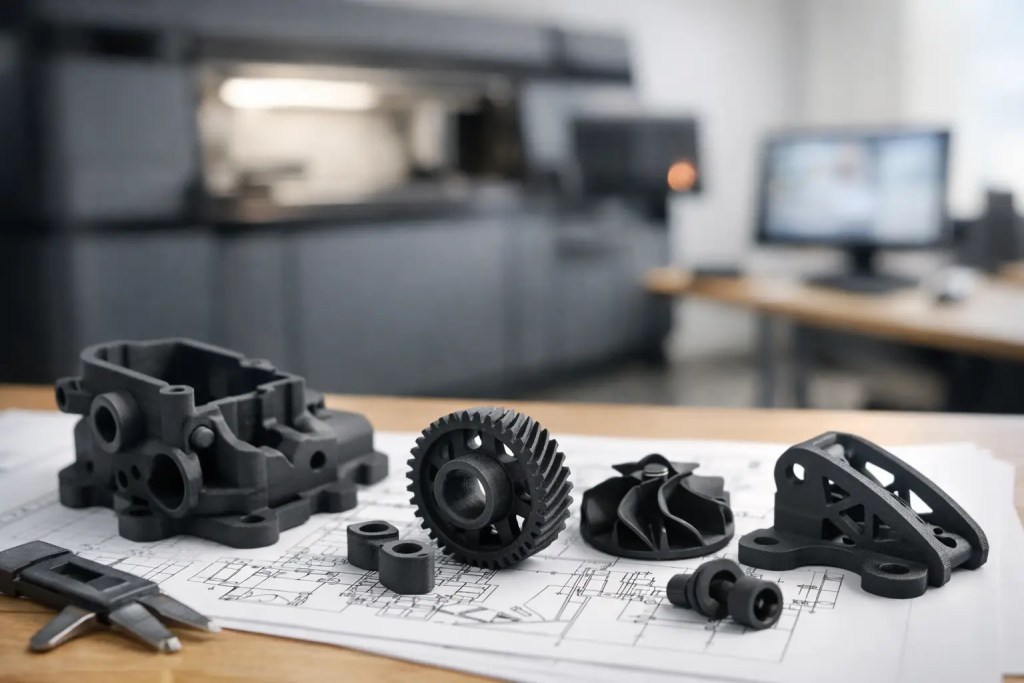
MJF sits in a practical space between prototyping and full tooling. It is often the right choice when a team needs anywhere from tens to low thousands of polymer parts and cannot justify the time, cost, or inflexibility of injection molding yet. That includes housings, brackets, guides, covers, clips, and custom fixtures where function matters more than cosmetic Class A surfacing.
The strongest production use cases usually share the same constraints. Demand is real, but not stable enough to commit to tooling. Design revisions may still happen. Multiple SKUs or variants are required. Procurement wants predictable turnaround. Engineering wants mechanical performance closer to an end-use thermoplastic than a visual prototype material can provide.
MJF addresses those constraints well because it combines relatively fast build cycles with good dimensional consistency and material properties suited to functional use. In PA12 especially, parts can achieve a useful balance of strength, stiffness, chemical resistance, and wear performance. That makes the process viable for more than concept validation.
An MJF production parts case study in practical terms
Consider a manufacturer launching a compact industrial device with several polymer components: an internal cable guide, a snap-fit service cover, and a mounting bracket. Initial builds were machined and hand-finished, which worked for engineering validation but not for release. The next step had to support 300 to 800 units across several product variants, with the possibility of geometry updates after field feedback.
Injection molding looked attractive on piece price, but the tooling commitment was difficult to justify. Each design revision would add cost and delay. CNC machining offered precision, but part geometry and labor content pushed costs too high for the projected volumes. That left a gap between prototype flexibility and production economics.
MJF was selected for the first production run because it reduced that gap. Parts were consolidated, support-free build preparation simplified production planning, and the team could release functional nylon components without waiting for hard tooling. More importantly, the process allowed design iteration without restarting the economics of the program.
This is where case studies become meaningful. The result is not simply a faster print. The result is a production pathway that preserves agility while still delivering traceable, repeatable output.
Why MJF works for short-run production
The biggest reason is consistency across batches when the process is managed correctly. MJF produces parts within a controlled powder-bed environment, which generally leads to more stable results than many engineers expect from additive manufacturing. Surface finish is typically more uniform than legacy powder-bed polymer methods, and feature quality is good enough for many mechanical parts without major secondary work.
Another advantage is part density and isotropic behavior relative to many filament-based alternatives. For production components that will see handling, assembly loads, snap features, or light-duty mechanical service, that matters. A part that survives lab testing but fails in repeated use is not production-ready.
MJF also supports packing efficiency. Multiple components and variants can be nested into a single build, which helps teams managing product families or bridge production. If demand changes, the next build can be adjusted without stranded tooling or minimum order concerns.
That said, process fit still matters. If the application requires very tight cosmetic control, clear parts, elastomeric behavior outside qualified materials, or molded-grade economics at very high volume, MJF may not be the right answer. It is a production tool, not a universal replacement for conventional manufacturing.
What separates a good result from a risky one
A useful MJF production parts case study should not stop at speed. It should show how the part was engineered for the process and how quality was controlled.
Geometry is the first factor. Parts designed with appropriate wall sections, fillets, lattice opportunities, and realistic tolerances will perform more predictably than designs lifted directly from machining or molding assumptions. Snap-fits, living features, and hole definitions often need process-specific review. Small changes at the CAD stage can significantly improve yield and consistency.
Material choice comes next. PA12 is often the baseline because it offers a dependable balance of mechanical performance and dimensional stability. PA11 may be preferred when greater ductility is needed. The correct choice depends on the actual use environment – impact loading, heat exposure, chemical contact, and service life all change the recommendation.
Then there is post-processing. Not every production part needs the same finish. Some parts can ship as-built after depowdering and inspection. Others require dyeing, bead blasting, machining of critical interfaces, threaded inserts, or tighter secondary inspection for mating features. Production readiness is often defined by the total workflow, not the print alone.
The quality question engineers and buyers actually care about
For production, repeatability matters more than a single successful batch. Teams need confidence that parts ordered this month and next month will assemble the same way, perform the same way, and arrive on a predictable schedule.
That is why supplier capability matters as much as machine capability. An ISO 9001:2015-certified workflow gives buyers a clearer framework for document control, inspection discipline, and process consistency. It does not eliminate engineering trade-offs, but it reduces avoidable variability introduced by poor handling, inconsistent setup, or weak revision control.
In practice, production success depends on controlled quoting, manufacturability review, material traceability, standardized finishing, and inspection aligned to the application. A bracket for internal use may need a different inspection approach than an end-use enclosure with visible surfaces and mating interfaces. Good suppliers treat those as defined production requirements, not informal assumptions.
Cost, lead time, and where the break-even really shifts
One reason MJF is attractive is that it changes the cost curve. Tooling-heavy methods become more economical as volume rises, but they carry an upfront penalty and slower response to change. MJF keeps entry cost low and lead time short, which is valuable when demand is uncertain or product evolution is still active.
That does not mean MJF is always cheaper per part. At higher volumes, injection molding will often win on unit economics. The real comparison is total program cost. If tooling, engineering changes, inventory risk, and time-to-market are included, MJF can be the better production decision even when the nominal piece price is higher.
This is especially true for bridge production, spare parts, regional fulfillment, or products with multiple low-volume variants. In those cases, flexibility has real financial value.
Where an operational partner changes the outcome
The strongest results usually come from working with a supplier that can support more than one process. If a part begins in MJF for launch quantities but later moves to injection molding, CNC machining, or another additive process for a specific reason, the transition should not require starting vendor qualification from zero.
That broader production view is useful because MJF is often one stage in a longer manufacturing plan. A service bureau such as Additive3D Asia can help teams qualify MJF for short-run production, then recommend when another process becomes more suitable based on geometry, annual demand, tolerance requirements, or finishing needs.
For engineering and procurement teams, that reduces friction. The goal is not to force every part into one technology. The goal is to place each part in the process that best balances performance, cost, and lead time.
What this means for your next program
If you are evaluating MJF for production, the right question is not whether the process can make functional parts. It can. The better question is whether your part, volume, revision risk, and quality requirements align with what MJF does well.
When they do, MJF can shorten release cycles, avoid premature tooling spend, and support dependable short-run manufacturing with industrial-grade nylon materials. That is the real lesson behind any credible case study.
The most useful next step is simple: review the part as a production system, not just a CAD file. The best manufacturing decisions usually start there.