
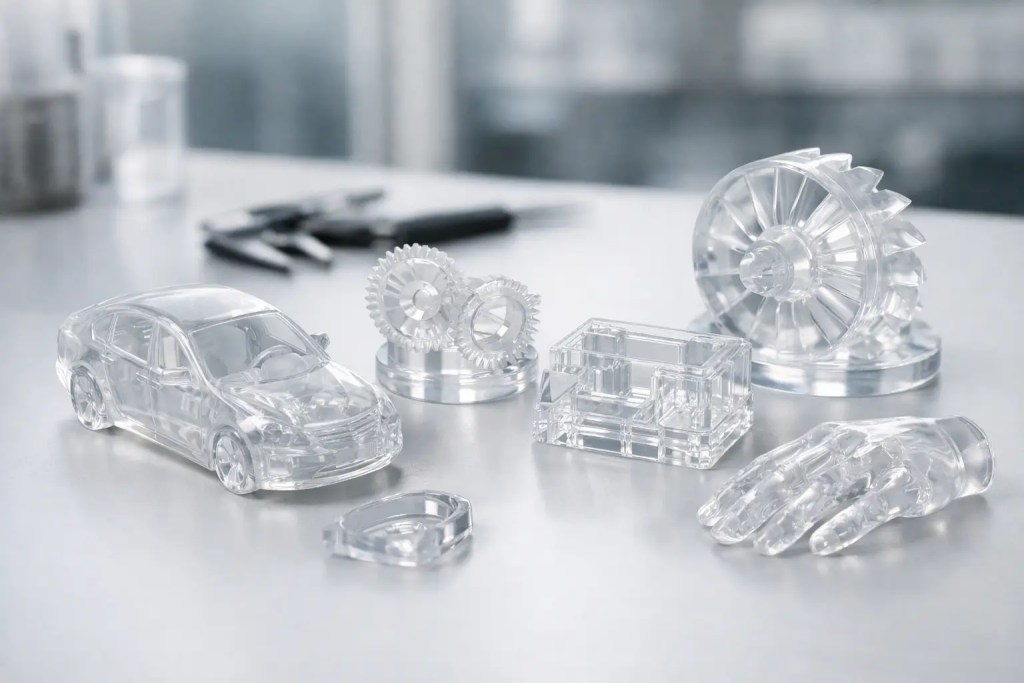
A light pipe that looks clear on screen can fail fast in physical testing. The issue usually is not the CAD. It is whether the prototype process can reproduce optical paths, internal channels, fine geometry, and surface quality closely enough to support a real engineering decision. That is where transparent resin prototype applications become useful. They give product teams a practical way to evaluate visibility, fluid movement, fit, and user-facing appearance early, without waiting for tooling.
For engineering teams, the value is not just visual realism. Transparent resin parts can reduce iteration risk when a design depends on line of sight, liquid level indication, light transmission, or inspection access. In the right context, they are faster and more cost-effective than machined clear plastics for early validation. But they are not a direct substitute for production-grade polycarbonate or acrylic in every case. Process capability, post-processing, and the performance target all matter.
Where transparent resin prototype applications make sense
The most common use case is visual access. If a housing, reservoir, manifold, or cover needs to reveal what is happening inside, a transparent resin prototype can help confirm whether the design works before a hard tool is cut. Engineers use these parts to inspect internal clearances, monitor fluid paths, review assembly interactions, and present a near-production appearance to stakeholders.
Medical and laboratory device development is a strong example. Teams often need to verify fluid routing, bubble formation, valve placement, or reagent visibility inside compact geometries. A transparent prototype allows bench testing with direct observation. It also supports design reviews where internal functionality is difficult to explain through opaque parts alone.
Consumer electronics teams use clear resin for light guides, display covers, and cosmetic models where surface finish and visual intent matter. In automotive and mobility programs, transparent prototypes are used for lens concepts, sensor covers, and housings that require sight-line evaluation. Industrial equipment developers rely on them for inspection windows, protective covers, and enclosures where internal component visibility improves serviceability.
These parts also work well for sales samples and investor demonstrations, especially when a product’s internal mechanism is a core feature. A clear prototype can communicate design intent quickly. That said, presentation models and engineering validation models are not always the same part. The first prioritizes appearance. The second prioritizes dimensional fidelity, function, and repeatability.
What transparent resin can and cannot prove
This is where many projects go off track. A clear SLA part can show geometry, transparency, and fine detail very well, but it does not automatically prove long-term optical performance, UV stability, impact resistance, or chemical compatibility at production levels. If the final part will be injection molded in optical-grade resin, the prototype should be treated as a decision tool, not a final material proxy.
For fit checks, assembly reviews, and flow visualization, transparent resin is often highly effective. For optical testing involving precise refractive behavior, demanding scratch resistance, or prolonged outdoor exposure, it depends on the application and acceptance criteria. Some teams only need directional validation – whether the LED path is generally correct, whether the user can read a fill level, whether internal turbulence is visible. Others need quantitative optical data. Those are very different requirements.
Mechanical performance is another trade-off. Resin parts can be accurate and detailed, but they may be more brittle than the thermoplastics used in production. Thin clips, snap fits, and high-stress interfaces should be reviewed carefully. If a part must survive repeated load cycles, a different process or a hybrid validation plan may be the better path.
Transparent resin prototype applications in product development
In practice, transparent resin prototypes are most useful when they answer a specific engineering question. If the goal is broad exploration, almost any clear part may help. If the goal is sign-off for tooling, the part has to be matched much more tightly to the risk being retired.
Fluid handling and internal flow review
Clear manifolds, microfluidic components, pump covers, and reservoirs are common candidates. Teams use these prototypes to observe flow direction, detect dead zones, and check how seals and connectors interact in assembled conditions. Internal channels that would be impossible to inspect in an opaque print become visible during benchtop testing.
The limitation is that surface texture inside small channels can affect flow behavior. Support strategy, print orientation, and post-processing all influence the result. If the channel performance is critical, the prototype should be reviewed not only for geometry but also for internal surface condition.
Optical covers, lenses, and light pipes
Transparent resin can support early studies for LED diffusion, indicator visibility, and cover geometry. It is especially useful when teams need to compare multiple design iterations quickly. Wall thickness, rib placement, and edge conditions can be reviewed in physical form without waiting for machined samples or pilot tooling.
Still, there is a difference between a visually clear sample and an optically controlled component. If glare, distortion, or exact transmission values are central to product performance, teams should define what the prototype is expected to prove before selecting the process.
Enclosures with viewing windows
Industrial products often require operators to inspect fill level, mechanism position, or process status through a window or clear cover. Transparent resin prototypes help confirm line of sight, mounting approach, gasket compression, and maintenance access. This can be valuable in machine design, process equipment, and handheld instrumentation.
Because these parts are often handled during reviews and testing, scratch sensitivity should be considered. A part that looks clear at handoff may haze over after repeated use if finishing and handling controls are not managed properly.
Medical and lab device visualization
In regulated or semi-regulated development environments, seeing internal function during prototyping can shorten troubleshooting cycles. Transparent resin parts allow engineers and cross-functional teams to inspect flow, dosage movement, mixing behavior, and assembly interactions directly. That makes design reviews more efficient and often exposes problems that a CAD review misses.
Dimensional accuracy matters here, especially for mating features and small passages. Repeatable process control and documented workflows are more important than a one-off visually attractive sample.
Process considerations for transparent resin prototype applications
SLA is usually the preferred process when high detail, smooth surfaces, and clear material output are required. It can reproduce fine geometry and relatively sharp features well, making it suitable for covers, channels, and visually critical models. But raw printed clarity is only part of the result. Washing, UV curing, sanding, polishing, and sometimes clear coating have a major impact on final appearance.
That means procurement teams should not compare clear prototypes on material name alone. The finishing route affects transparency, dimensional outcome, and lead time. A quick prototype for internal design review may need only basic finishing. A customer-facing display sample may require a much higher level of surface work.
Orientation also matters. Layer direction and support placement can influence visible surfaces, optical quality, and the cleanup effort required. Features such as internal cavities, undercuts, and thin walls can change the manufacturing strategy significantly. Good DFM support early in quoting can prevent unrealistic expectations around clarity or delivery time.
For some programs, transparent resin is only the first step. Once geometry is validated, teams may move to CNC machined clear plastic, urethane casting, or injection molding depending on volume and the final performance target. That staged approach is often more efficient than trying to force one prototype process to answer every question.
How engineering teams should specify clear prototypes
A better RFQ leads to a better part. Instead of asking for a “clear prototype,” define the actual requirement. Does the part need to show internal flow, approximate a cosmetic lens, support leak testing, or simply validate packaging and fit? Each target points to a different process window.
Call out the critical surfaces, tolerance-sensitive interfaces, and what level of transparency is needed. Full visual clarity is not always necessary. Sometimes translucency is enough to inspect fluid movement or confirm internal component location. If a scratch-free cosmetic face matters, identify it clearly. If threaded ports, gasket lands, or sealing surfaces are critical, note those as well.
It also helps to separate must-have requirements from nice-to-have ones. A prototype intended for engineering validation may prioritize speed, accuracy, and repeatability. A prototype for executive review may prioritize visual finish. When both goals are combined into one part without a clear priority, cost and lead time usually increase.
For teams managing multiple development gates, a manufacturing partner with both additive and conventional processes can reduce transition risk. Additive3D Asia supports that kind of progression by matching prototype intent to the right process, material, and finishing path rather than treating every clear part as the same job.
Transparent resin prototypes are most effective when they are used with discipline. They are excellent for seeing what opaque parts hide, accelerating iteration, and improving decision quality early in development. The key is to ask a precise question, choose the process to answer it, and treat the prototype as part of a broader validation plan. When that happens, a clear part does more than look good on the bench – it helps teams move to production with fewer surprises.