
A metal part that looks perfect in CAD can still warp on the build plate, trap powder in an internal channel, or require so much machining that additive stops making economic sense. That is the real challenge in how to design metal printed parts – not just making geometry printable, but making it stable, inspectable, and production-ready.
For engineering teams using metal additive manufacturing, especially selective laser melting (SLM), design decisions carry direct consequences for cost, lead time, yield, and final performance. A good design reduces support volume, controls distortion, and leaves enough stock where precision finishing matters. A poor one creates avoidable risk at every step after quoting.
How to design metal printed parts for the process, not just the model
The first shift is practical. Designing for metal printing is not the same as designing for machining, casting, or polymer additive processes. SLM builds parts layer by layer under high thermal loads, which means the process rewards some geometries and penalizes others.
Thin walls, large flat spans, and abrupt section changes are common problem areas. A thin feature may print, but it may also distort under residual stress or become vulnerable during support removal. A heavy solid block may seem safer, yet it stores heat and increases build time and material use. In many cases, the better design is neither the thinnest nor the most massive option. It is the geometry that balances stiffness, thermal stability, and practical finishing access.
Part orientation matters just as much as shape. The same model rotated 30 degrees can print with a different support strategy, different surface quality, and different distortion risk. Down-facing surfaces generally require more support and finish differently than upward-facing or vertical surfaces. If one face needs better cosmetic or functional quality, orientation should reflect that from the start.
This is why manufacturability review should happen before release, not after. Engineers who treat orientation, support, and post-processing as part of the design phase usually get faster approvals and fewer revisions.
Start with the function of the part
Before adjusting fillets or hollowing out sections, define what the part actually has to do. Is it a lightweight structural bracket, a heat-resistant fixture, a fluid manifold, or an end-use component under cyclic loading? The answer changes the design approach.
A bracket designed for static loading in AlSi10Mg may allow aggressive weight reduction and lattice-backed stiffness. A fixture in SS316L may prioritize toughness, corrosion resistance, and simple post-machining at critical interfaces. A part that must hold a sealing surface or threaded connection needs deliberate machining allowance, even if most of the geometry is additively produced.
This is also where material selection should happen. Engineers sometimes finalize geometry first and choose the metal later, but material properties influence wall sizing, support sensitivity, heat behavior, and finishing response. Aluminum alloys and stainless steels do not behave identically in print or in service. If the application requires tight dimensional control, pressure retention, or repeated mechanical loading, those constraints should guide the design from the beginning.
Control mass and thermal stress
One of the most common mistakes in metal AM is carrying over conventional solid geometry where it is not needed. Solid sections increase build time and often intensify residual stress. In SLM, thermal management is a design issue, not just a machine parameter.
Where possible, keep wall thickness consistent and avoid sudden transitions from very thick to very thin sections. If a thick area is necessary, blend the change gradually with radii or tapered transitions. Sharp thermal contrasts can increase distortion during the build and after support removal.
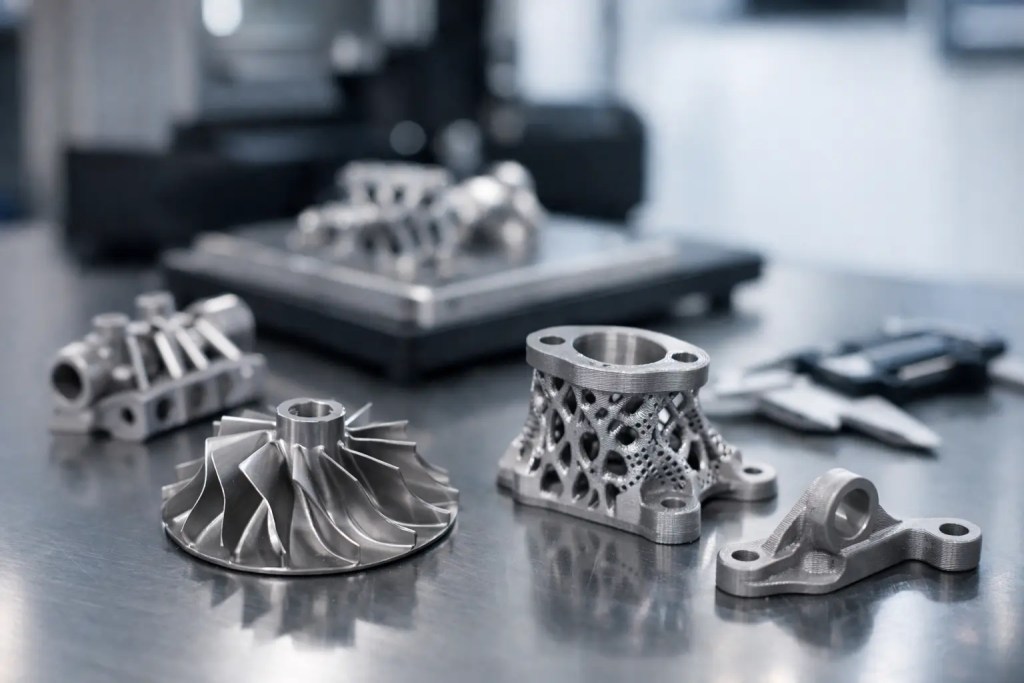
Hollowing can help, but only when it is done responsibly. Internal cavities reduce weight and print time, yet they also raise powder evacuation questions. If powder cannot be removed reliably, the feature may create more manufacturing risk than value. Internal channels should have a clear purpose and practical escape paths.
Large unsupported horizontal surfaces are another warning sign. They tend to sag or print with poor surface quality on the down-facing side. Sometimes a small design change, such as splitting one broad underside into angled faces, can reduce support demand significantly.
Design supports out, not in
Support structures are necessary in metal printing, but they should be treated as a cost and risk to minimize. More support means more material, more build preparation, more removal work, and more chance of damaging the part during post-processing.
The best support strategy begins with geometry. Self-supporting angles, smoother transitions, and thoughtful orientation usually do more than trying to solve everything in preprocessing software. If a feature requires heavy support in every orientation, reconsider the feature.
That does not mean designing only simple parts. It means reserving complexity for where it improves function. Internal channels, lattice regions, and weight-optimized forms can all work well in metal AM, but each should justify its manufacturing burden.
Access matters here. If supports are placed inside a cavity or beneath a critical feature, can they actually be removed? If the answer is no, the design is not production-ready yet. This is especially important for enclosed geometries, overhang-rich pockets, and internal manifolds.
Build tolerances around finishing steps
Engineers asking how to design metal printed parts often focus on as-printed geometry and underestimate what happens afterward. In most industrial applications, metal printed parts are not truly finished when they come off the machine. They may need stress relief, support removal, bead blasting, machining, tapping, sealing surface refinement, or heat treatment.
That means tolerances should be assigned by feature type, not applied uniformly across the model. Broad non-critical surfaces can often remain as-printed. Precision bores, bearing fits, sealing faces, and datum features usually need secondary machining.
A reliable design leaves stock where machining is expected and protects the surfaces that must remain accessible. Threads are a good example. Printed threads may be acceptable in some low-load applications, but many production parts benefit from printed pilot geometry followed by tapping or thread milling. The same logic applies to precision holes. If hole size and roundness matter, machine them after print rather than depending on as-built results.
This is where process planning and design should meet. If a fixture will be needed to machine the part later, add reference faces or clamping features early. A part that prints successfully but cannot be held securely for finishing is only halfway designed.
Internal features need inspection logic
Metal additive makes internal geometry possible, but not every printable channel is a good production feature. If a passage cannot be depowdered, inspected, or verified, it introduces quality risk.
For fluid paths, cooling channels, and enclosed manifolds, think beyond geometry. How will trapped powder be removed? How will the feature be checked after build? Is the internal roughness acceptable for the application, or will flow performance suffer? In some designs, additive gives a clear advantage. In others, splitting the part for inspection or combining additive with machining creates a more controlled result.
Design for verification is especially important in regulated or repeat-production environments. Engineering teams that include inspection access, datum strategy, and critical-to-function dimensions up front usually move faster into stable supply.
When to simplify, and when complexity pays off
Metal AM earns its value when it consolidates assemblies, reduces weight, shortens lead times, or enables geometry that conventional methods cannot produce efficiently. It does not automatically improve every metal part.
If a component is essentially a simple prismatic block with a few drilled holes, machining may remain the better process. If the part combines mounting interfaces, internal routing, and topology-driven weight reduction, additive becomes much more compelling. The decision should be based on total manufacturing outcome, not process preference.
That is why design for metal printing is usually a hybrid exercise. Some surfaces are optimized for the build. Others are intentionally left for machining. Some geometries are consolidated. Others are split because assembly is still the cleaner route. The best result is rarely the most complex shape possible. It is the part that meets performance targets with predictable manufacturing control.
At Additive3D Asia, this is usually where experienced review adds the most value – not by forcing a generic rule set, but by matching geometry, material, and finishing requirements to a repeatable production route.
A practical workflow for how to design metal printed parts
A disciplined workflow helps avoid late design changes. Start by identifying the functional loads, operating environment, and truly critical features. Then select the metal based on those requirements, not on familiarity alone.
From there, model the part around likely build orientation and support behavior. Reduce unnecessary mass, smooth section transitions, and check whether internal features can be depowdered. Mark all surfaces that need machining, threading, sealing quality, or tighter tolerances than the print process can reliably hold.
Finally, review the design as a full manufacturing chain. Ask whether the part can be printed, stress-relieved, cleaned, supported, removed, inspected, machined, and shipped without hidden bottlenecks. That sequence is what separates a printable CAD file from a production-capable part.
The strongest metal AM designs are rarely the ones with the most aggressive geometry. They are the ones that respect the process, protect the critical features, and arrive at final inspection with fewer surprises. If you design with the whole route in mind, the part has a much better chance of performing exactly as intended when it leaves the build chamber and when it reaches the field.