

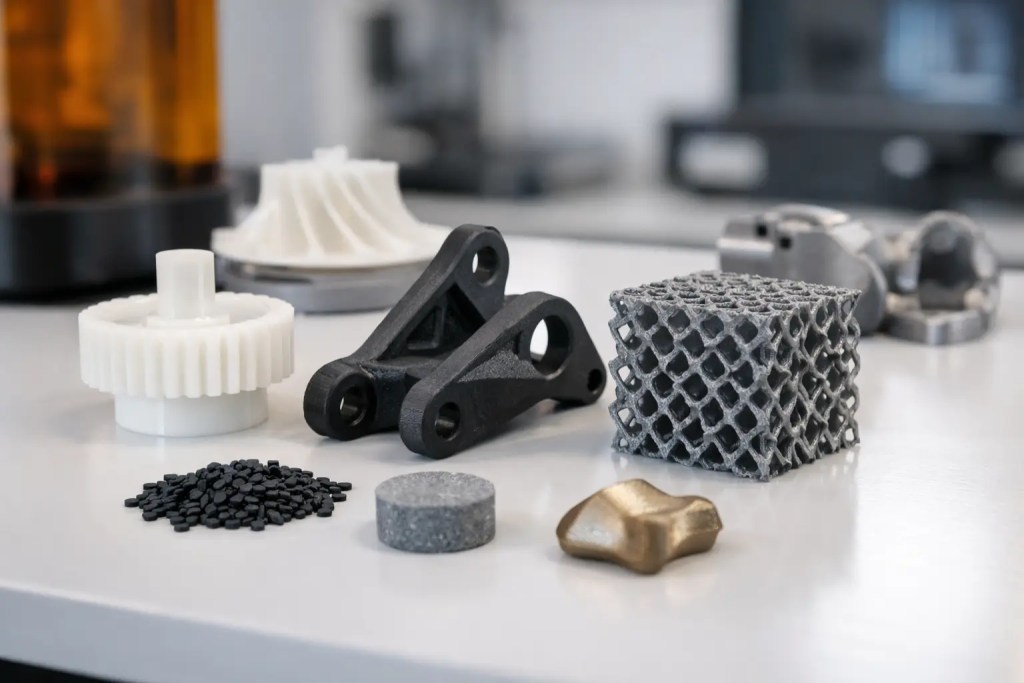
A prototype that looks right but fails in testing usually has the same root cause – the material was selected too early, or for the wrong reason. Teams often focus on geometry and process first, then treat material as a dropdown choice. In practice, the better question is: which material should I choose for the actual load case, environment, finish requirement, and production target?
That question matters because material selection drives more than mechanical performance. It affects dimensional stability, post-processing, lead time, unit cost, and whether a prototype can transition into a bridge or end-use part without a redesign. If you are working across prototyping, validation, and low-volume production, material choice should be part of the manufacturing decision from the start.
Which material should I choose first?
Start with function, not brand names or process preferences. An engineering resin, a nylon powder, and a machined metal part can all look viable on paper, but they behave very differently under impact, heat, long-term loading, or chemical exposure.
A useful filter is to define the part in four practical terms: what loads it sees, what environment it operates in, what level of accuracy and finish it needs, and how many parts you need now versus later. Once those are clear, material selection becomes narrower and more defensible.
For example, a concept model for stakeholder review does not need the same material as a functional enclosure that will be assembled repeatedly. A fixture used on a production line needs a different priority set than a cosmetic display model. Material should follow application, not habit.
Match the material to the job
For functional polymer parts
If you need a strong, production-relevant polymer, nylon is often the starting point. PA12 is widely used because it balances strength, stiffness, dimensional stability, and chemical resistance well. It is a dependable choice for housings, brackets, covers, ducts, and general functional prototypes.
PA11 is typically the better fit when toughness and ductility matter more. If a part will see impact, repeated flexing, or a less brittle response under load, PA11 can outperform PA12 even if the headline numbers appear similar. The trade-off is that material choice may affect cost and the final stiffness profile.
For components that need isotropic performance and strong mechanical properties, powder-bed polymer processes often support better functional outcomes than filament-based parts. That matters for clips, snap-fit features, and load-bearing geometries where directional weakness is a risk.
For high-detail visual parts
When surface finish, feature resolution, and appearance drive the requirement, photopolymer resins are usually the better route. These materials work well for presentation models, master patterns, housings with cosmetic requirements, and complex geometries with fine details.
The trade-off is straightforward: many high-detail resins look excellent but are less forgiving in long-term functional use. They may be more brittle than nylon and less suitable for sustained mechanical stress or elevated temperatures. If the part will be handled, assembled, or tested under real operating conditions, appearance alone should not drive the choice.
For general-purpose prototypes and fast iterations
FDM materials still have a place, especially when speed and budget matter more than finish. Common thermoplastics can support early-stage fit checks, basic functional testing, and internal development cycles.
That said, anisotropy, visible layer lines, and lower dimensional consistency can become limiting factors. If your prototype needs to represent end-use performance closely, a low-cost material may create false confidence or force rework later.
For metal end-use parts
If the part requires high strength, heat resistance, wear resistance, or direct use in an industrial environment, metal becomes the right discussion. Aluminum alloys such as AlSi10Mg are often selected for lightweight structural parts, heat-managed components, and geometries that benefit from additive design freedom.
SS316L is a common choice when corrosion resistance, toughness, and broad industrial suitability are more important. It is often appropriate for tooling components, brackets, manifolds, and hardware exposed to demanding environments.
Metal materials bring clear performance advantages, but they also raise the bar on design discipline, support strategy, post-processing, and cost control. If a polymer can meet the requirement reliably, it may still be the better manufacturing decision.
Which material should I choose based on performance?
The fastest way to narrow the field is to rank your actual priorities.
If strength and stiffness are the main requirement, reinforced polymers, engineering nylons, machined plastics, or metal alloys should lead the shortlist. If impact resistance matters more than stiffness, a tougher polymer may outperform a more rigid one in service.
If the part sits near motors, electronics, or hot process equipment, heat resistance becomes a gate, not a preference. A material that passes room-temperature bench testing may creep, soften, or deform in real operating conditions. The same logic applies to UV exposure, humidity, oils, solvents, and cleaning chemicals.
If your part includes mating features, threaded inserts, sealing surfaces, or tight assembly interfaces, dimensional behavior matters just as much as tensile values. Some materials are mechanically strong but less stable through printing and post-processing. Others machine cleanly after printing, which may be the better route when tolerance matters.
And if visual quality is customer-facing, define what that actually means. A smooth surface, sharp edges, paint readiness, and color consistency are not the same requirement. Material and process selection should reflect the finish standard you need after post-processing, not just as-printed appearance.
Material choice also affects production strategy
A common mistake is choosing the material only for prototype performance, without thinking about what happens at 50, 200, or 1,000 units. Some materials are excellent for validation but inefficient for repeat production. Others transition well from prototype to bridge manufacturing and even into stable low-volume supply.
That is where process breadth matters. A part initially built in nylon for speed may later move to injection molding for cost efficiency. A printed master may become a urethane casting tool for small batches. A metal prototype may prove the geometry before CNC machining takes over for tighter tolerances on production volumes.
The right material is not always the one with the best standalone property set. It is the one that supports the full manufacturing path with the least friction, from prototype through release.
Questions engineers should answer before selecting a material
Before locking in a material, confirm a few specifics internally. What is the maximum service temperature? Is the load static, cyclic, or impact-based? Does the part need to flex, snap, seal, or thread? Is the surface cosmetic, functional, or secondary? Does the component need certification, traceability, or repeatability across multiple builds?
These questions sound basic, but they prevent the most expensive kind of mistake – selecting a material that solves the first test and creates a problem everywhere else.
In an ISO 9001:2015-controlled manufacturing environment, material selection should support repeatable outcomes, not one-off success. That means choosing materials with known behavior, stable process windows, and a realistic path to inspection and finishing.
A practical way to decide
If you are still comparing several options, do not force a single answer too early. Shortlist two candidates: one optimized for performance and one optimized for speed or cost. Then test them against the actual requirement, not assumptions.
For many teams, the best path is simple. Use PA12 for broad functional polymer needs, PA11 where toughness is more critical, resin materials where detail and finish lead, and metal alloys such as AlSi10Mg or SS316L where service conditions demand it. If the part may migrate to another process later, factor that in before release.
At Additive3D Asia, this is usually where material selection becomes a manufacturing decision rather than a catalog exercise. The right answer comes from matching geometry, performance target, and production intent to a process-material combination that can be repeated with control.
If you are asking which material should I choose, the most useful answer is rarely the strongest or cheapest option on a datasheet. It is the material that lets the part work as intended, pass validation, and move into production without surprises.