
When a prototype needs to look production-ready in a customer meeting, the wrong process shows up immediately. Surface texture, part lines, color consistency, and small visual defects all become part of the evaluation. That is why the choice between SLA vs vacuum casting for appearance prototypes matters early – not just for aesthetics, but for timeline, budget, and decision quality.
For engineering and product teams, these two processes often compete for the same brief: a high-finish prototype that communicates design intent clearly. But they solve different manufacturing problems. SLA is usually the faster route for one-off visual models and detailed geometry. Vacuum casting becomes more compelling when you need multiple copies with a molded look and more production-like materials.
SLA vs vacuum casting for appearance prototypes: the practical difference
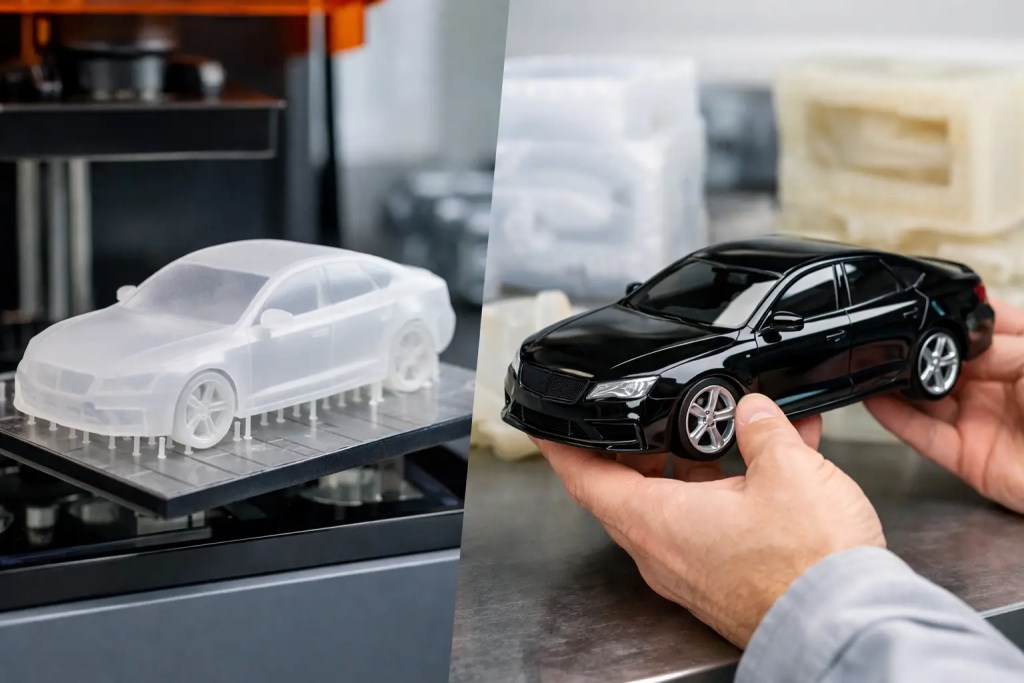
SLA, or stereolithography, builds parts layer by layer from liquid photopolymer resin using a laser. It is known for fine feature resolution, smooth surfaces compared with many other 3D printing processes, and strong cosmetic potential after post-processing. For appearance prototypes, SLA is often selected when teams need one to a few parts quickly and want sharp detail, clean edges, and a premium finish.
Vacuum casting starts differently. A master pattern is created first, often by 3D printing or CNC machining, then used to make a silicone mold. Polyurethane resin is poured into that mold under vacuum to reduce air entrapment and improve surface quality. The result is a cast part that can closely mimic injection-molded appearance, especially across small batches.
If the part count is one, SLA often wins on speed and simplicity. If the part count is ten or twenty and visual consistency matters, vacuum casting usually starts to make more economic and cosmetic sense.
Where SLA performs best
SLA is strong when the design is still moving. If your industrial design team expects another CAD revision after the first review, printing directly from the latest file avoids mold-making cost and delay. You can move from CAD upload to part production quickly, which helps compress approval cycles.
It also handles intricate features well. Small text, thin ribs, cosmetic contours, and complex internal geometry are generally easier to achieve in SLA than in vacuum casting, where mold design and demolding constraints can influence what is practical. For show models, housings, and ergonomic studies, that precision can be more valuable than material realism.
Another advantage is lower entry cost for single parts. There is no mold to amortize, so the first article is relatively economical compared with casting. If a team needs one painted enclosure for a board presentation, SLA is usually the cleaner path.
That said, SLA is not automatically the best cosmetic option in every case. Raw SLA parts still require post-processing to reach a high-end appearance standard. Support marks, print orientation effects, and finishing labor all influence the final result. A good SLA prototype can look excellent, but the process discipline behind sanding, priming, and painting matters as much as the printer itself.
Where vacuum casting performs best
Vacuum casting is built for repeatability across low-volume prototype runs. Once the master and silicone mold are approved, multiple parts can be produced with consistent texture, color, and overall appearance. That is a major advantage for design validation, investor samples, distributor kits, or internal stakeholder reviews where every unit needs to present the same way.
It also gives teams more production-like visual cues. Because the parts are cast in molds, they often resemble molded plastics more closely than printed parts do. For products that will eventually be injection molded, that can make vacuum casting a better bridge between prototype and production.
Material behavior can also be more representative, depending on the resin selected. While appearance prototypes are primarily visual, they are rarely purely decorative. Teams may still want snap fits, light assembly checks, or basic handling tests. Vacuum-cast urethanes can sometimes provide a closer approximation to end-use plastics than SLA photopolymers, especially when toughness and feel matter.
The trade-off is setup. You are paying for the master, the mold, and the casting process before you get the first finished part. If the design changes right after that, some of that investment may need to be repeated.
Surface finish and visual quality
For appearance prototypes, this is usually the deciding factor.
SLA delivers high detail and can achieve very smooth surfaces, especially on well-oriented geometries with proper finishing. It is excellent for sharp cosmetic definition. Transparent or translucent visual models are also common with SLA, although true optical clarity depends heavily on post-processing.
Vacuum casting tends to produce a more uniform cosmetic result across multiple units. Because the surface comes from the mold, texture reproduction is more consistent from part to part. If you need five enclosures in the same color with the same sheen for a sales review, vacuum casting has an edge.
Neither process is maintenance-free from a finishing standpoint. SLA parts may need more hands-on surface refinement to remove build artifacts. Vacuum-cast parts can still show gate marks, parting lines, or minor variation depending on mold design and resin behavior. The right choice depends on whether you are optimizing for the best-looking single sample or the most consistent small batch.
Lead time, quantity, and cost
SLA is generally faster for the first part. There is no tooling phase, which makes it suitable for urgent concept models and design reviews. If you need one part tomorrow or a few parts this week, SLA is often the practical answer.
Vacuum casting adds front-end time because the mold has to be created. For a stable design, that setup time is justified by better economics over several units. As quantity increases, the cost per part usually becomes more favorable than finishing multiple SLA parts individually.
This is where many teams misjudge the process. They compare only the price of one SLA part against one cast part. That is not the real decision. The better comparison is total project cost at the required quantity, cosmetic standard, and revision risk.
If the design is unstable, SLA protects you from retooling cost. If the design is locked and the quantity is above a handful of units, vacuum casting often becomes the better-managed spend.
Design constraints and revision risk
SLA is more forgiving during active development. You can print difficult geometries without thinking much about draft, split lines, or mold release. That freedom helps in the early phase when the main goal is to evaluate form.
Vacuum casting introduces manufacturing logic earlier. Undercuts, wall thickness transitions, and geometry that complicates mold release can affect cost, quality, or mold life. That is not a disadvantage if the prototype is meant to simulate production intent. In fact, it can be useful because it pushes the design toward manufacturability sooner.
Revision risk is the key variable. If your team expects multiple design changes, SLA usually keeps iteration faster and cheaper. If the CAD is stable and the next step is stakeholder validation on several identical units, vacuum casting is typically the stronger choice.
How to choose between SLA and vacuum casting
A simple way to make the decision is to start with the program objective, not the process.
If the prototype is for a single executive review, design approval, or packaging fit check, SLA is often sufficient and faster. If the prototype needs to support a small launch simulation, user demo set, or customer sampling round, vacuum casting is usually more aligned with the outcome.
It also helps to ask what failure looks like. If failure means the part arrives late, choose the process with the shortest path to first article. If failure means the parts do not look consistent across a batch, choose the process that controls repeatability better.
For many projects, the answer is not either-or. A common route is to use SLA for the first visual proof, approve geometry and finish direction, then move to vacuum casting once the design is frozen and quantity increases. That staged approach reduces risk while keeping procurement and production efficient.
An ISO 9001:2015-controlled manufacturing workflow adds another layer here. Appearance prototypes are judged visually, but they are managed operationally. Repeatable quoting, file handling, process control, and finishing standards all affect whether the delivered parts match the design intent. That is especially relevant when timelines are tight and parts need to ship globally without repeated clarification.
The best prototype process is the one that answers the real question in front of the team. If you need speed, detail, and low-friction iteration, SLA is hard to beat. If you need a molded look, batch consistency, and better alignment with low-volume pre-production, vacuum casting usually carries the project further. Start with the decision you need the prototype to support, and the right process becomes much easier to specify.